



When someone needs a roof replacement, they’re not comparing engineering specs. They’re comparing trust. And today, trust lives online. A homeowner will check your Google rating, skim a few reviews, glance at your photos, and decide in seconds whether you’re worth calling.
If you run a roofing company, that means your online reputation is already working for you or quietly working against you. This guide keeps things simple: what reputation management for roofing companies means, why it affects your lead flow, and how to get it under control without turning it into a second job.
What Is Roofing Reputation Management?

In roofing, “reputation management” just means shaping what people see when they search your name. It's your online word-of-mouth, which usually shows up as:
- Your star rating on Google
- Number of reviews you have
- How recent are these reviews
- What customers say (mess, delays, communication, cleanup, etc.)
- How you respond when things go right or wrong
Roofing services' online reputation management shouldn’t revolve around hiding every bad review or buying fake ones. It’s not effective.
Instead, roofing reputation management should focus on three things:
- Making it easy for happy customers to speak up
- Catching problems early and fixing what you can
- Showing future customers that you’re responsive, honest, and still in business
Not every opinion is controllable, but you can build simple habits and systems that tilt things in your favor: more 5-star jobs showing up online, fewer angry surprises.
Why Your Online Reputation Can Make or Break Your Roofing Business
This is how it happens: a homeowner usually finds three or four roofers in a local search. They don't know any of you, so they rely on the fastest shortcut available: reviews.
If you're at 4.7 stars with 150+ reviews and your competitor is at 3.9 stars with 18 reviews, you know who they're calling first. Same price, same area, but your reputation wins you the lead before you ever pick up the phone. It's one of the cleanest forms of roofing lead generation because every call comes to you pre-qualified.
A strong profile also makes it easier to:
- Close at fair or premium pricing ("these guys clearly know what they're doing")
- Get more referrals ("we trusted them, you can too")
The goal of roofing reputation management is simple: make sure your online reputation works for you, not against you.
How Homeowners Judge Your Roofing Reputation in Seconds
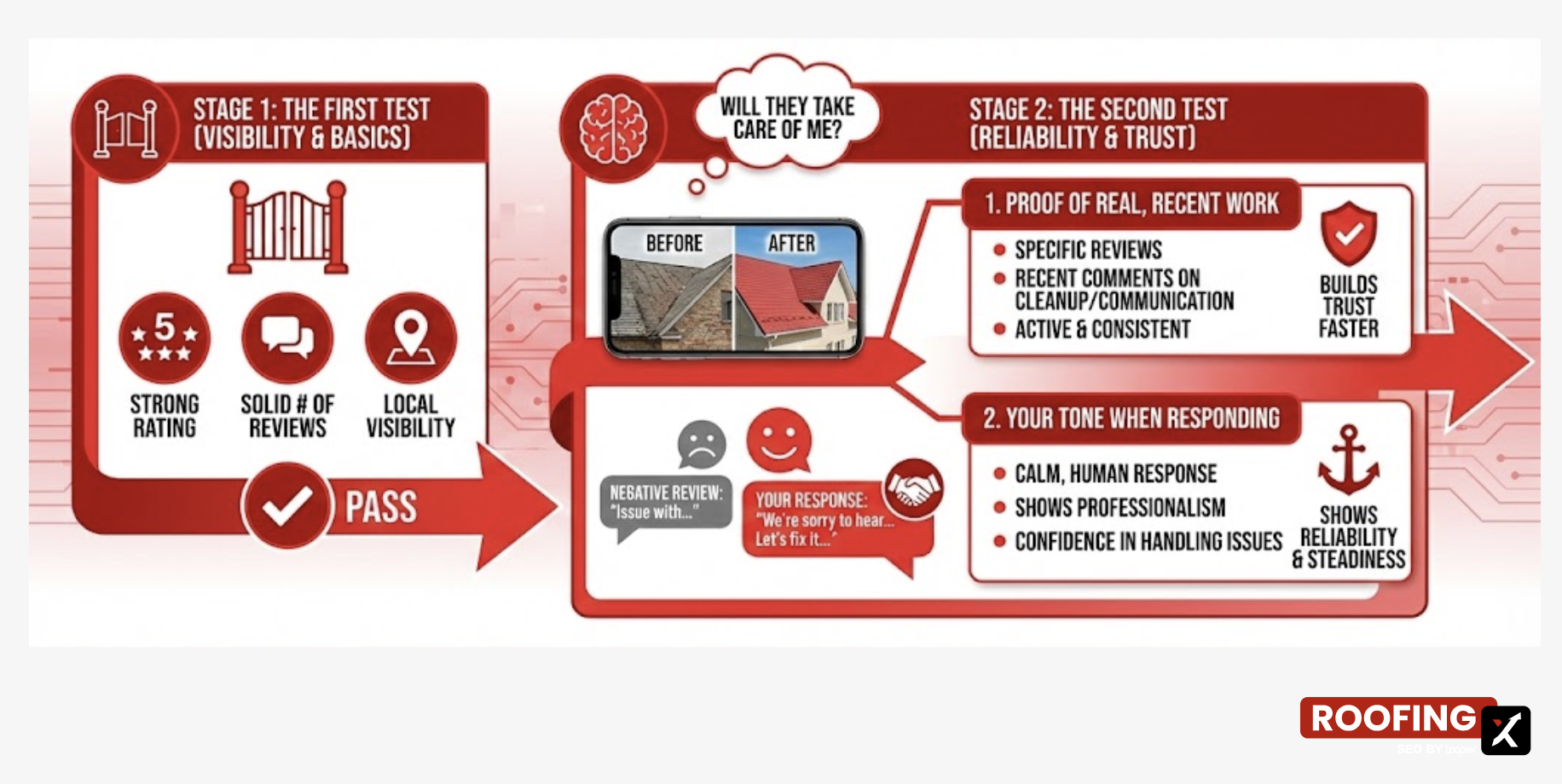
Once your profile passes the first test (strong rating, solid number of reviews, and local map pack visibility) homeowners start looking for signs that you're the kind of roofer who won't create headaches for them.
At this stage, they're not comparing technical skills. They're looking for small signals that answer one question: "Will this company take care of me if something goes wrong?"
Two things matter most here:
1. Proof of real, recent work
Homeowners look for before-and-after photos, job details, and reviews that sound specific, not generic one-liners. When they see comments about cleanup, communication, or how quickly you handled an issue, it builds trust faster than any marketing pitch. It reassures them you're active, consistent, and used to dealing with homes like theirs.
2. Your tone when responding to reviews
People almost always scan at least one negative review. They're not judging the mistake; they're judging your reaction. A calm, helpful, human response shows professionalism and gives them confidence that you won't disappear or argue if something unexpected happens.
By this point, homeowners aren't choosing the cheapest roofer, but rather the one who looks reliable, steady, and easy to work with. Your online reputation helps you prove that before you ever speak to them.
Why Your Website Content Also Shapes Your Roofing Reputation
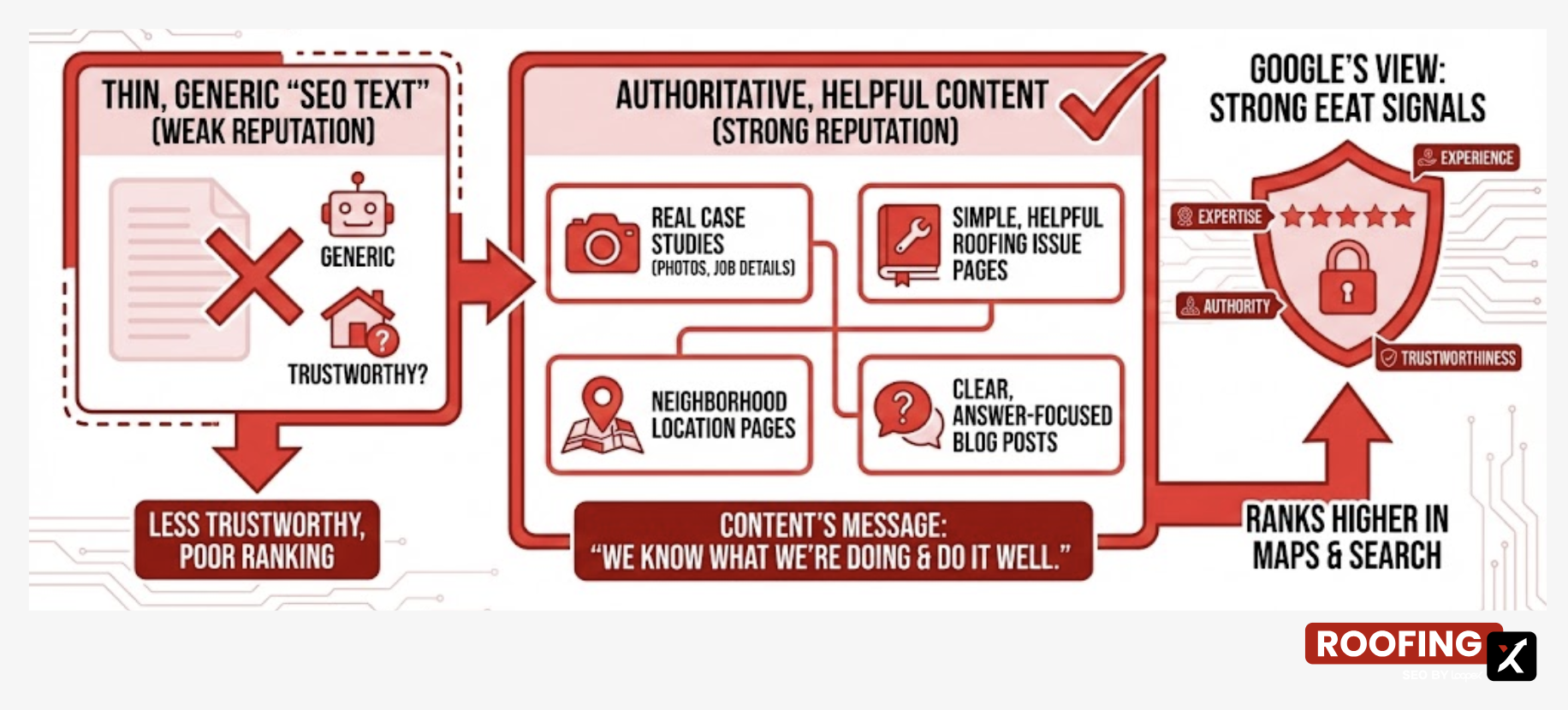
Online reputation isn't just reviews. Google also judges your expertise based on the content you publish. If your website is thin, outdated, or filled with generic "SEO text" instead of real content writing for roofers, Google sees you as less trustworthy, and homeowners feel that too.
What builds authority online is content that proves you know your craft:
- Real case studies with photos and job details
- Pages that explain roofing issues in simple, helpful language
- Location-based roofing landing pages that show you actually work in those neighborhoods
- Blog posts that answer common roofing questions clearly (not fluff)
This kind of content sends the same message good reviews do: "We know what we're doing, and we do it well."
It also helps you rank higher in Google Maps, organic search, and AI search optimization for roofing companies by strengthening your EEAT (Experience, Expertise, Authority, and Trustworthiness) signals.
If you feel like your reviews are good but your website isn't telling your story well enough, that's something we help with. Our roofers SEO company writes content based on real homeowner questions, real job data, and what actually moves the needle for ranking.
Whenever you're ready, just contact us, and we can support you with the content side of your reputation, too.
How to Build a Review System That Strengthens Your Roofing Reputation Every Week

The easiest way for roofing reputation management is to build a routine that gets happy customers talking. Scripts, long emails, or pressure tactics won’t work here. Instead, follow these three simple steps:
Step 1. Ask at The Right Moments
A review request works best when the homeowner has just seen good work or good service. For most roofing jobs, those moments are predictable:
- after a smooth inspection,
- once the installation is finished, or
- right after the final cleanup, when the customer is relieved that the project went well.
Catching people while the experience is fresh makes them far more likely to leave a genuine review.
Step 2. Make it Effortless
People will leave a review if you make it a one-tap action. A direct Google Review link, a quick text, or a QR code on a card during the walkthrough removes all friction. The shorter the ask, the better. Something as simple as “Here’s the link if you’re willing to share a quick review” works.
Step 3. Automate the Follow-Up
If you want reviews consistently (not only when you remember), automation helps. Tools like Podium, NiceJob, Birdeye, or Broadly can send a polite reminder by text or email for you. You don’t need software to start, but using one keeps the process steady, even on your busiest weeks.
With a simple system like this, you’ll slowly build the kind of review pattern homeowners trust immediately: recent, steady, and specific.
How to Respond to Reviews for Better Roofing Reputation Management
Homeowners read your tone more than your wording. Simply sound human, stay calm, and show you care enough to follow up.
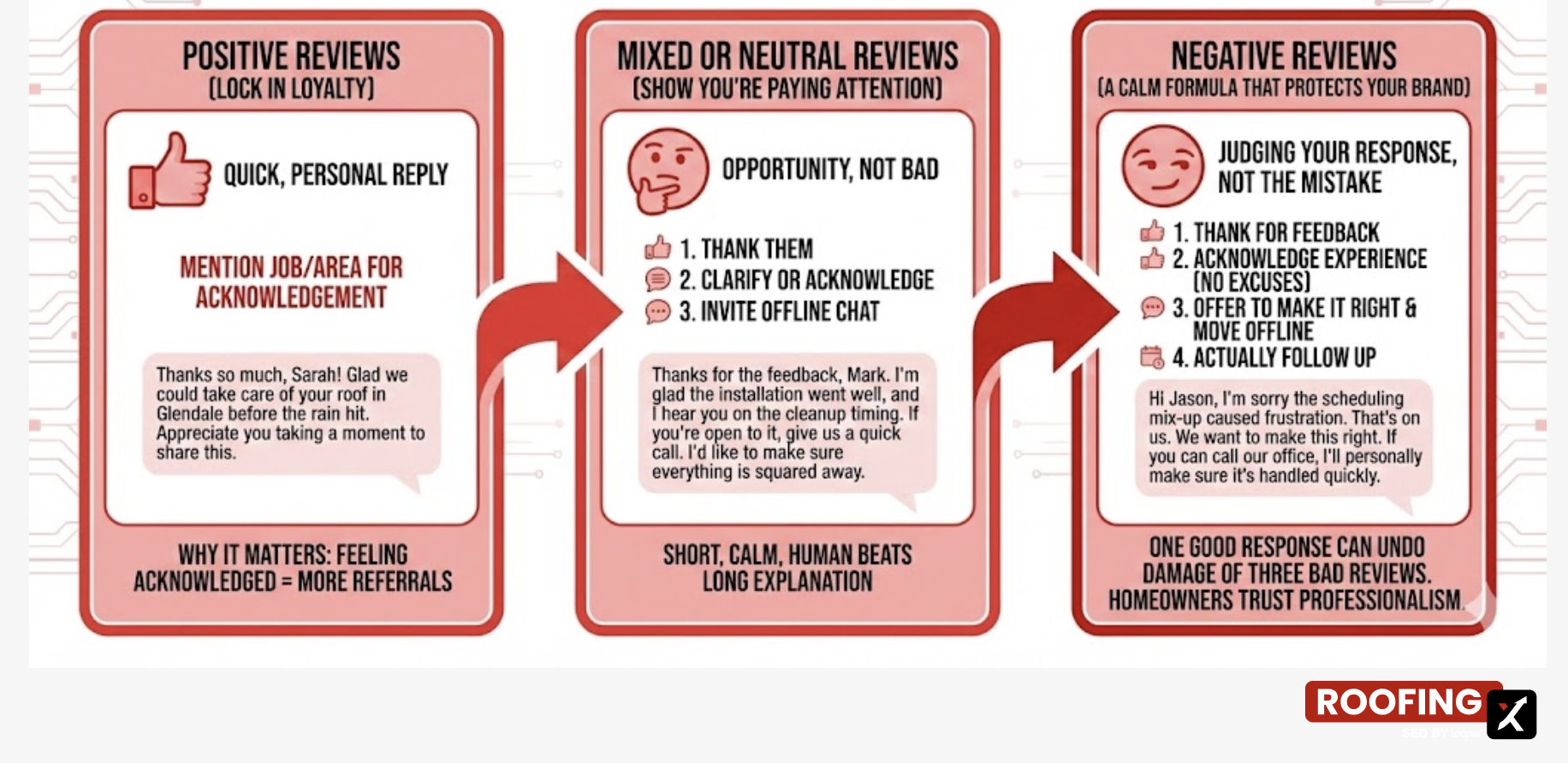
Positive Reviews (Lock in Loyalty)
A quick, personal reply is all you need. Mention the job or area so the homeowner feels seen.
Example: “Thanks so much, Sarah! Glad we could take care of your roof in Glendale before the rain hit. Appreciate you taking a moment to share this.”
Why it matters: People who feel acknowledged are more likely to refer you, and referrals arrive already trusting you.
Mixed or Neutral Reviews (Show You’re Paying Attention)
These aren’t bad reviews; they’re opportunities. A simple structure works every time:
- Thank them
- Clarify or acknowledge
- Invite a quick offline chat
Example: “Thanks for the feedback, Mark. I’m glad the installation went well, and I hear you on the cleanup timing. If you’re open to it, give us a quick call. I’d like to make sure everything is squared away.”
Short, calm, and human beats any long explanation.
Negative Reviews (A Calm Formula That Protects Your Brand)
People check your worst reviews on purpose, but they’re not judging the complaint. They’re judging your response. Use this simple four-step formula:
- Thank them for the feedback
- Acknowledge their experience (no excuses)
- Offer to make it right and move the conversation offline
- Actually follow up
Example: “Hi Jason, I’m sorry the scheduling mix-up caused frustration. That’s on us. We want to make this right. If you can call our office, I’ll personally make sure it’s handled quickly.”
This shows future customers you’re responsible, not reactive. One good response can undo the damage of three bad reviews, because homeowners trust professionalism more than perfection.
What to Do About Fake, Unfair, or Over-the-Top Reviews
Every roofing company gets a few reviews that feel completely off: the wrong customer, the wrong company, or someone venting about something unrelated. Do not panic. Most homeowners can spot a bizarre review, and Google removes plenty of them when flagged correctly.
Reviews You Should Flag vs. Reviews You Should Answer
A review is worth flagging when it’s obviously unrelated or abusive. For example:
- talking about a job you never did,
- mentioning locations or people you don’t recognize,
- personal attacks or spam, or
- posts that look like a competitor trying to cause trouble.
These don’t require debate. Just flag them and move on.
If the review is negative but still connected to a real job, it’s better to respond calmly than to argue or report it. We covered this earlier.
How to Flag a Review
Flagging a review on Google is simple:
- Open the review.
- Click the three dots.
- Select “Report review.”
- Choose the closest reason.
- Move on with your day.
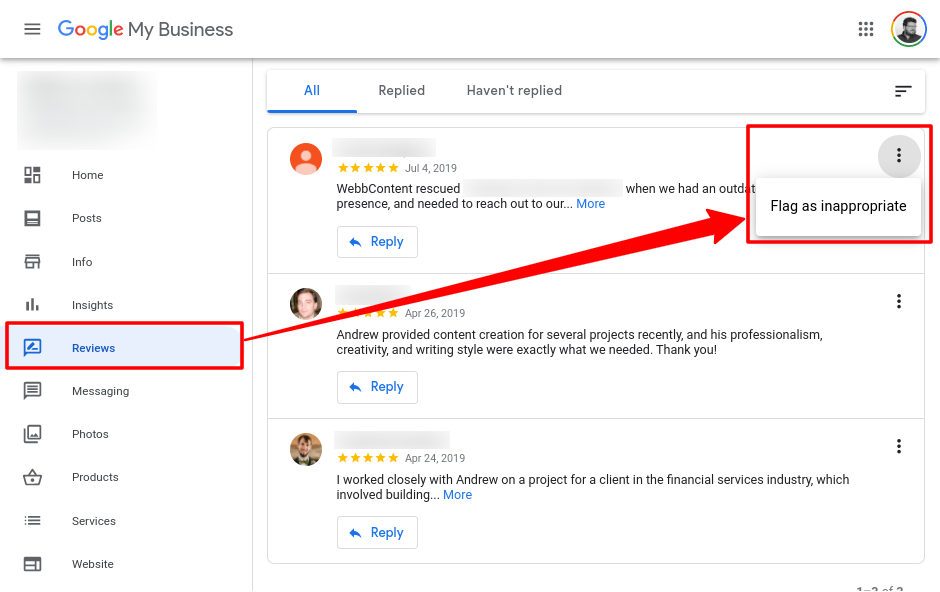
That’s it. There’s no magic paragraph to convince Google; a short, clear reason is enough. And don’t spend hours refreshing your profile waiting for action. Google may take days or weeks.
Your time is better spent helping real customers and collecting new, positive reviews that push the outlier down the page.
How to Make Roofing Reputation Management Part of Your Marketing
Your reviews are one of your strongest assets, and when you incorporate them into your marketing, it becomes much easier to stand out from local competitors who rely solely on ads or discounts.
Connect Reviews to Your Local SEO
Google rewards roofing companies that look active, trustworthy, and engaged with customers. A steady stream of recent reviews tells Google you're still working in your area, which helps your business show up in local map results where most homeowners make their decisions. Strong reviews compound when you pair them with solid on-page SEO for roofers.
Your Google Business Profile is the heart of this. If it's complete, updated, and consistently earning new reviews, almost everything else gets easier: rankings, calls, and trust.
Use Reviews Everywhere Homeowners See You
Don't let great feedback live in one place. Bring it into the rest of your marketing so homeowners see social proof no matter where they find you.
- Add testimonials or a review carousel to your roofing website design
- Share short screenshots on social media
- Include a small review quote in your estimates or follow-up emails
When people repeatedly see proof from other homeowners, credibility builds. You can read the "Review Management" section in our roofing SEO guide for deeper insights.
Multi-Platform Presence Without Burning Out
Prioritize Google first; that's where nearly every roofing search begins. After that, encourage the occasional review on Facebook, and let BBB, Yelp, or Angi be optional add-ons.
Guide different customers to different platforms over time. Someone who already uses Facebook daily might prefer leaving a review there, while another person will happily tap your Google link.
This spreads your reputation out without extra work and keeps all your profiles looking alive without any stress. It's one of the simplest moves in any digital marketing plan for roofers
Takeaways: Your Weekly Roofing Reputation Management Checklist
Now that you know the basics, it helps to turn them into simple habits. You can print this list, save it to your notes app, or hand it to your marketing manager, whatever keeps it in front of you each week.
These tasks are small, but together they shape how homeowners see your business:
- Check Google, Facebook, and any review sites you use 2-3 times a week.
- Respond to every new review (the tone matters more than the length).
- Ask a few satisfied customers for a review as part of your close-out routine.
- Post one or two recent job photos to your Google Business Profile.
- Once a month, compare your rating and review count with local competitors.
Doing these consistently builds the kind of steady, trustworthy online presence homeowners rely on when choosing a roofer. If you're starting from behind, maybe a low rating, very few reviews, or a profile that hasn't been touched in a while, don't stress. Every strong reputation you see today started with small, simple steps for roofing reputation management.
If you feel you need deeper guidance or want support from people who've rebuilt online reputations for other roofing companies, our roofing SEO services can help you get the right systems in place. Just reach out when you're ready. You don't have to figure it all out alone.
FAQs
How much does reputation management cost?
Roofing reputation management can range from $500 to $2,500/month for small roofing businesses, $2,500 to $10,000/month for mid-sized companies that need content creation, PR, and advanced SEO, and $10,000 to $50,000/month for enterprise-level brands dealing with complex reputation issues (Source).
Why do roofers have a bad reputation?
Mainly because of poor communication, slow follow-ups, messy job sites, or disappearing after payment: all issues that a strong reputation management for roofing companies is designed to fix.
What is the best marketing for roofers?
Local SEO, a strong Google Business Profile, steady reviews, and clear before/after photos are the highest-ROI strategies for roofers today.


.webp)