|
Term
|
Definition
|
|
Algae Discoloration
|
Dark streaks caused by algae growth, common in humid climates; mostly cosmetic.
|
|
ARMA
|
Asphalt Roofing Manufacturers Association; sets industry standards and guidance.
|
|
Architectural Shingles
|
Thicker, layered asphalt shingles that add dimension and better wind resistance.
|
|
Asphalt
|
Petroleum-based material used in shingles, underlayment, and roof cement for waterproofing.
|
|
Asphalt Primer
|
Liquid coating applied before asphalt products to improve adhesion.
|
|
Asphalt Roof Cement
|
Thick adhesive used to seal flashing, shingles, and small repairs.
|
|
Asphalt Shingle
|
Most common residential shingle made of asphalt-coated mat with granules.
|
|
ASTM
|
Organization that sets material testing standards used in roofing specs.
|
|
Attic Vent
|
Opening or device that allows heat and moisture to escape the attic.
|
|
Back Surfacing
|
Sand or mineral coating on the back of shingles to prevent sticking.
|
|
Base Flashing
|
Flashing installed first at walls or chimneys to direct water away.
|
|
Base Sheet
|
Bottom layer in multi-ply or modified bitumen systems.
|
|
Base-Ply Sheet
|
First ply installed in built-up or modified bitumen roofing.
|
|
Blend
|
Mix of colors or shingles to create a uniform roof look.
|
|
Blisters
|
Raised bubbles in shingles caused by trapped moisture or heat.
|
|
Bridging
|
Shingles failing to lie flat due to uneven decking or improper nailing.
|
|
Building Components
|
All structural and exterior parts that make up the roof system.
|
|
Built-Up Roof
|
Multi-layer roof system made of bitumen and reinforcing fabric.
|
|
Built-Up Roofing (BUR)
|
Same as built-up roof; often called tar and gravel roofing.
|
|
Bundle
|
Pack of shingles; typically three bundles equal one roofing square.
|
|
Butt Edge
|
Bottom edge of a shingle that overlaps the course below.
|
|
Cant Strip
|
Angled strip that helps roofing transition smoothly to vertical surfaces.
|
|
Cap Flashing
|
Protective flashing installed over base flashing.
|
|
Cap Sheet
|
Top layer of a modified bitumen or BUR system.
|
|
Caulk
|
Flexible sealant used to close small gaps and joints.
|
|
Cement
|
General term for adhesives used in roofing (often asphalt-based).
|
|
Chalk Line
|
String coated with chalk used to mark straight lines during installation.
|
|
Class A Fire Resistance
|
Highest fire resistance rating for roofing materials.
|
|
Class B Fire Resistance
|
Moderate fire resistance rating.
|
|
Class C Fire Resistance
|
Basic fire resistance rating.
|
|
Class 4 Impact Resistance
|
Highest impact rating for shingles, tested against hail damage.
|
|
Closed Cut Valley
|
Valley style where shingles are cut in a straight line over flashing.
|
|
Closed Valley
|
Valley covered by shingles rather than exposed metal.
|
|
Coating
|
Liquid layer applied to protect or extend roof life.
|
|
Collar
|
Ring or seal around roof penetrations like pipes.
|
|
Collars
|
Plural of collar; seals around multiple penetrations.
|
|
Concealed Nail Method
|
Nails are hidden under shingles for better water protection.
|
|
Condensation
|
Moisture buildup from warm air meeting cold surfaces.
|
|
Cool Roof Shingle
|
Reflective shingle designed to reduce heat absorption.
|
|
Counter Flashing
|
Secondary flashing layered over base flashing, often in masonry.
|
|
Course
|
A single horizontal row of shingles.
|
|
Coverage
|
Area a roofing material covers, usually per square or bundle.
|
|
Cricket
|
Raised structure that diverts water around chimneys.
|
|
Cupola
|
Decorative roof feature that can also provide ventilation.
|
|
Cutout
|
Notches in older shingle designs that create tab shapes.
|
|
Dead Level
|
Perfectly horizontal with no slope.
|
|
Deck / Decking
|
Flat surface attached to rafters or trusses that supports roofing materials.
|
|
Designer Shingle
|
Premium shingle designed to mimic slate, wood, or tile.
|
|
Dormer
|
Roof extension with a window that adds space and light.
|
|
Double Coverage
|
Two layers of material for added protection, often at eaves.
|
|
Downspout
|
Vertical pipe carrying water from gutters to ground level.
|
|
Drip Course
|
Course designed to help shed water away from edges.
|
|
Drip Edge
|
Metal edging that directs water into gutters.
|
|
Eave
|
Lower edge of the roof that overhangs walls.
|
|
Eave Flashing
|
Extra protection installed along eaves to prevent leaks.
|
|
Emissivity
|
Ability of a surface to release absorbed heat.
|
|
Exposed Nail Method
|
Nails are visible; more common on low-slope or roll roofing.
|
|
Exposure
|
Portion of shingle visible after installation.
|
|
Fascia
|
Vertical board at roof edge where gutters attach.
|
|
Felt
|
Traditional paper-based underlayment under shingles.
|
|
Fiberglass Mat
|
Reinforcing base used in modern asphalt shingles.
|
|
Flashing
|
Metal pieces that seal joints and transitions.
|
|
Flashing Cement
|
Adhesive used to seal flashing edges.
|
|
Gable
|
Triangular wall section under sloped roof edges.
|
|
Gable Roof
|
Roof with two sloping sides forming a ridge.
|
|
Gambrel Roof
|
Two slopes per side, commonly seen on barns.
|
|
Granules
|
Mineral coating on shingles that protects from UV rays.
|
|
Gravel Stop
|
Metal edge that holds gravel in place on flat roofs.
|
|
Gutter
|
Channel that collects rainwater from the roof.
|
|
Head Lap
|
Amount one shingle overlaps another vertically.
|
|
Hexagonal Shingles
|
Decorative shingles shaped like hexagons.
|
|
High Nailing
|
Nails placed too high, reducing shingle wind resistance.
|
|
Hip
|
External angle where two roof slopes meet.
|
|
Hip Roof
|
Roof sloping on all sides with hips instead of gables.
|
|
Hip Shingles
|
Special shingles used to cover hips and ridges.
|
|
Ice Dam
|
Ice buildup that blocks water flow and causes leaks.
|
|
Ice Dam Protection
|
Waterproof membrane installed at eaves to prevent ice damage.
|
|
Impact Resistant Shingles
|
Shingles designed to withstand hail impact.
|
|
Interlocking Shingles
|
Shingles that lock together for added wind resistance.
|
|
Laminated Shingles
|
Multi-layer shingles; another name for architectural shingles.
|
|
Lap
|
Overlapping of roofing materials.
|
|
Lap Cement
|
Cement used to seal overlaps in roofing materials.
|
|
Leaks
|
Water intrusion caused by failed materials or installation.
|
|
Lock Shingles
|
Shingles designed to mechanically lock together.
|
|
Low Slope Application
|
Roofing installation on roofs with minimal pitch.
|
|
Mansard Roof
|
Four-sided roof with steep lower slopes.
|
|
Mastic
|
Thick adhesive used for sealing and repairs.
|
|
Mid-Ply Sheet
|
Middle layer in multi-ply roofing systems.
|
|
Mineral Stabilizers
|
Fillers added to asphalt for strength and durability.
|
|
Mineral-Surfaced Roofing
|
Roofing with mineral granule surface for protection.
|
|
Modified Bitumen
|
Asphalt-based roofing reinforced with polymers.
|
|
Nailing Pattern
|
Required layout of nails for proper shingle performance.
|
|
Nails
|
Metal fasteners securing shingles and materials.
|
|
Nesting
|
Using different shingle patterns to reduce waste.
|
|
No-Cutout Shingles
|
Solid shingles without tabs or cutouts.
|
|
Non-Veneer Panel
|
Structural panel not used as decorative veneer.
|
|
Open Valley
|
Valley where metal flashing remains visible.
|
|
Organic Felt
|
Traditional felt made from cellulose fibers.
|
|
Organic Shingles
|
Older shingle type made with organic mat (less common today).
|
|
Overhang
|
Portion of roof extending beyond walls.
|
|
Overlayment / Recovering
|
Installing new roofing over existing materials.
|
|
Pallets
|
Platforms used to transport roofing materials.
|
|
Penetration
|
Any object passing through the roof (vents, pipes).
|
|
Pitch
|
Steepness of the roof.
|
|
Ply
|
Single layer in a multi-layer roofing system.
|
|
Ponding
|
Standing water remaining after 48 hours.
|
|
Primer
|
Pre-coating that improves adhesion.
|
|
Racking
|
Vertical shingle alignment that can look uneven.
|
|
Rafter / Rafters
|
Sloped beams supporting the roof deck.
|
|
Rake
|
Sloped edge along gable ends.
|
|
Random-Tab Shingles
|
Shingles with varied tab sizes for texture.
|
|
Release Tape
|
Plastic strip removed to activate sealing strip.
|
|
Reroofing
|
Installing a new roof over an existing one.
|
|
Ridge
|
Peak where roof slopes meet.
|
|
Ridge Cap Shingles
|
Shingles designed to cover ridges and hips.
|
|
Ridge Shingles
|
Same as ridge cap shingles.
|
|
Rise
|
Vertical height of roof slope.
|
|
Roll Roofing
|
Asphalt roofing sold in rolls for low-slope roofs.
|
|
Roof Deck Protection
|
Protective layer installed over decking.
|
|
Roof Ridge Vent
|
Vent installed along ridge for attic airflow.
|
|
Roofing Tape
|
Adhesive tape used to seal seams and repairs.
|
|
Run
|
Horizontal length in roof slope calculations.
|
|
Saturant
|
Asphalt that saturates felt or mats.
|
|
Saturated Felt
|
Felt infused with asphalt for waterproofing.
|
|
SBS
|
Rubber modifier that adds flexibility.
|
|
Seal Down
|
Process of shingles bonding via heat.
|
|
Self-Adhering Membrane
|
Peel-and-stick waterproof membrane.
|
|
Self-Adhering Shingle Underlayment
|
Adhesive underlayment installed under shingles.
|
|
Self-Sealing Shingles
|
Shingles with built-in adhesive strips.
|
|
Self-Sealing Strip or Spot
|
Adhesive area that bonds shingles together.
|
|
Selvage
|
Edge area of roll roofing for overlap.
|
|
Shading
|
Color variation from lighting or granule distribution.
|
|
Sheathing
|
Another term for roof decking.
|
|
Shed Roof
|
Single-slope roof design.
|
|
Shiner
|
Exposed nail head left uncovered.
|
|
Shingle Starter Strip
|
First course installed at eaves for sealing.
|
|
Shingles
|
Individual overlapping roof covering units.
|
|
Side Lap
|
Horizontal overlap between roofing materials.
|
|
Skirt Flashing
|
Flashing used around roof-mounted structures.
|
|
Slope
|
Angle of the roof surface.
|
|
Smooth-Surfaced Roofing
|
Roofing without mineral granules.
|
|
Soffit
|
Underside of roof overhang.
|
|
Soffit Vent
|
Vent installed in soffit for airflow.
|
|
Soil Stack
|
Vent pipe for plumbing system.
|
|
Solar Panels
|
Panels installed on roofs to generate electricity.
|
|
Span
|
Distance between structural supports.
|
|
Spire
|
Tall pointed roof element, often decorative.
|
|
Square
|
100 square feet of roofing area.
|
|
Square-Tab Shingles
|
Another term for 3-tab shingles.
|
|
Standard Slope Application
|
Roofing installation on typical pitched roofs.
|
|
Steep Slope Application
|
Roofing installation on steep roofs requiring extra safety.
|
|
Step Flashing
|
Individual flashing pieces layered with shingles.
|
|
Strip Shingles
|
Continuous asphalt shingles with cut tabs.
|
|
Synthetic Underlayment
|
Plastic-based underlayment with higher durability.
|
|
Tab
|
Individual section of a 3-tab shingle.
|
|
Talc
|
Powder used to prevent sticking during manufacturing.
|
|
Tear Off / Tear-Off
|
Removing old roofing before installing new.
|
|
Telegraphing
|
Deck imperfections showing through shingles.
|
|
Three-Dimensional Shingles
|
Architectural shingles with layered depth.
|
|
Top Lap
|
Upper overlap of roofing materials.
|
|
Truss
|
Factory-built roof framing unit.
|
|
UL
|
Underwriters Laboratories; tests safety and fire ratings.
|
|
UL Label
|
Mark showing UL certification.
|
|
Underlayment
|
Protective layer between decking and roofing material.
|
|
Valley
|
Area where two roof slopes meet.
|
|
Vapor Barrier
|
Layer that blocks moisture movement.
|
|
Vapor Diffusion Retarder
|
Slows moisture transfer rather than fully blocking it.
|
|
Vent
|
Opening that allows air movement.
|
|
Vent Pipe
|
Pipe that vents plumbing gases through the roof.
|
|
Vent Sleeve
|
Protective cover around vent pipes.
|
|
Ventilation
|
System that controls airflow and moisture.
|
|
Woven Valley
|
Valley formed by weaving shingles from both sides.
|





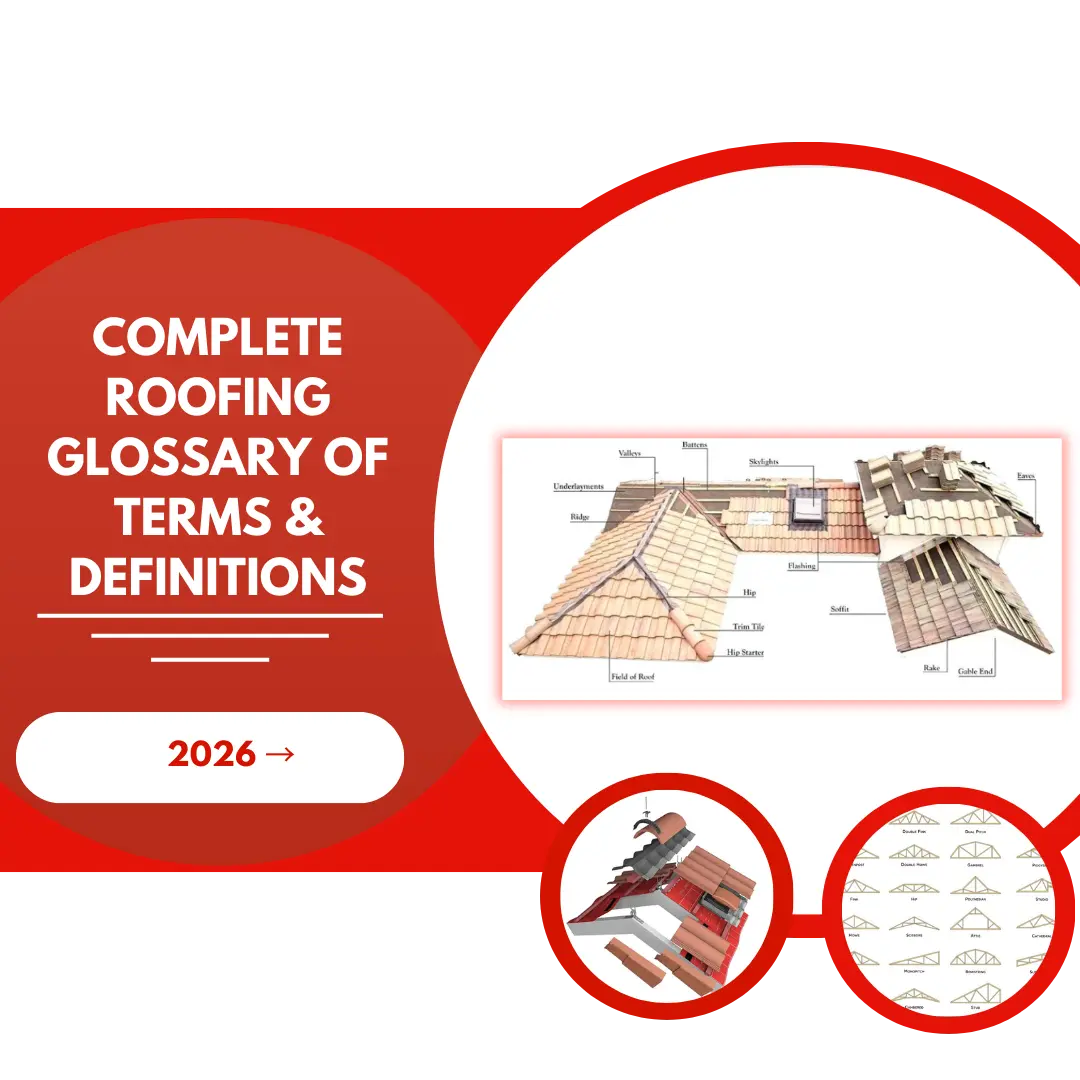



.webp)