



All roofers need marketing. And we bet you're already doing some kind of marketing. Knocking door-to-door? Marketing. Driving around in branded trucks? Marketing. Handing out business cards? Marketing.
In 2026, digital marketing for roofers comes down to one thing: being visible when homeowners search and ready when they decide to call. Everything else is noise.
This guide shows which digital channels generate roofing leads, how to use them together, and where most roofing companies waste budget without seeing results.
What Is Digital Marketing for Roofing Companies?
Digital marketing for roofers is everything you do online to generate qualified calls. That’s it.
It includes local roofing SEO to appear in Google Search and Maps, paid ads on Google and social platforms (like Facebook Ads), a website built to drive calls, and review management to build trust.
The simplest way to think about it: if it helps your phone ring, it’s digital marketing. Door knocking and yard signs still work, but digital marketing meets homeowners where they already search: online.
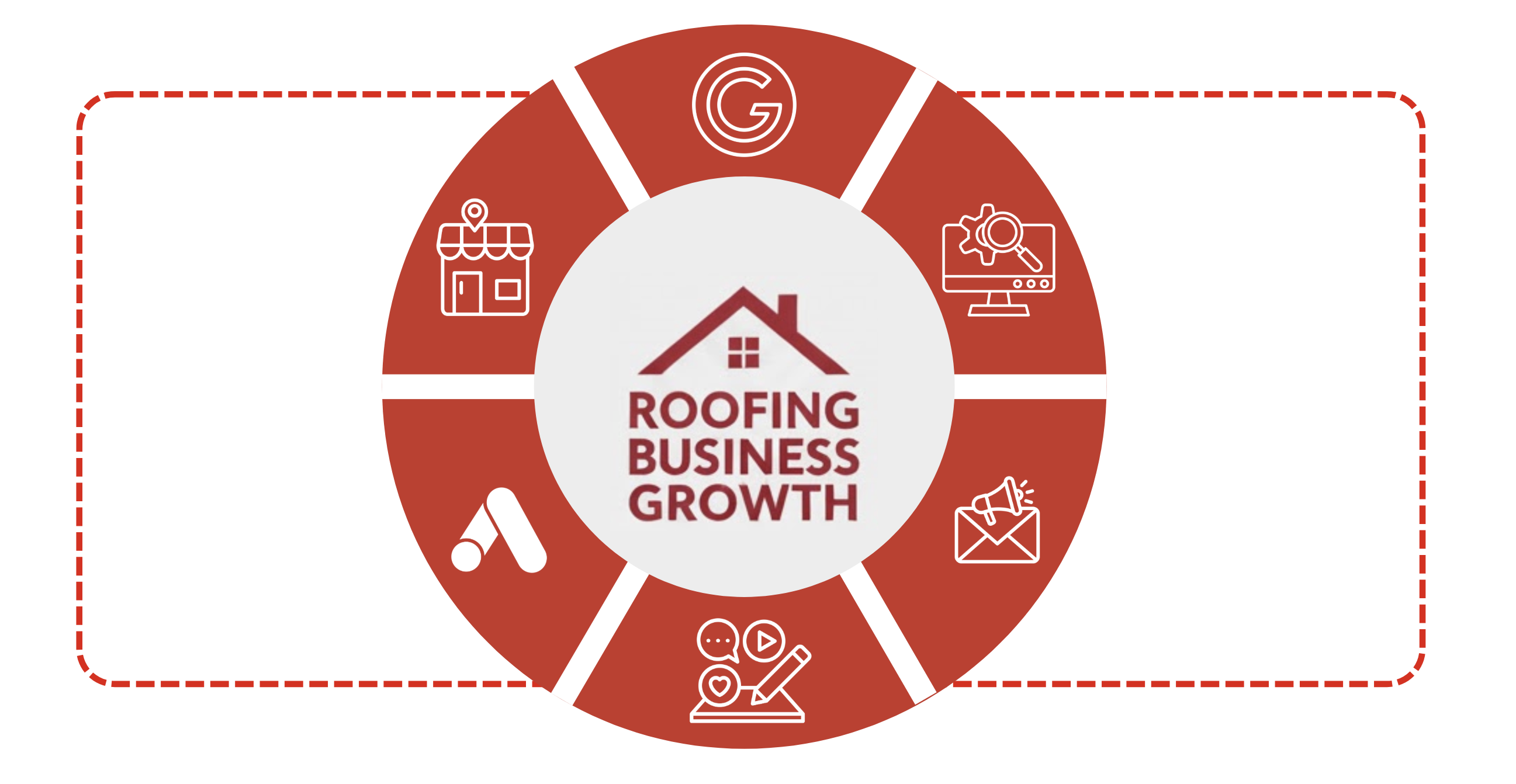
Here’s what each channel does:
- Local SEO: Gets your business visible when someone searches “roofer near me”
- Paid Advertising: Runs ads on Google and social platforms like Facebook to capture high-intent demand
- Website Optimization: Makes it easy to call or request an estimate on mobile
- Roofing Reputation Management: Collects and responds to Google reviews
- Content Marketing: Answers common roofing questions through blogs and videos
- Email Marketing: Stays in touch with past customers and warm leads
When these channels work together, digital marketing stops being “marketing” and starts producing jobs.
Why Roofers Need Online Marketing for Consistent Leads

Homeowner behavior has changed: before calling anyone, people search Google, read reviews, and compare a few options. If you’re not visible during that process, you don’t exist to them.
Meanwhile, your competitors are already investing in digital marketing for roofers. The ones ranking above you right now are capturing leads that could have been yours.
And today's buyers expect to find you online. First-time homeowners are buying later and skew tech-savvy — depending on the data source, the typical first-time buyer is now somewhere between their mid-30s and 40, the oldest on record. Most have education beyond high school and do real diligence before they ever call: reading reviews, comparing photos, lining up two or three quotes. A growing share live in connected, smart-device homes and expect the same digital convenience from a contractor — online estimates, easy scheduling, and a website that actually works on a phone. Show up where they're already looking, or lose them to the roofer who does.
The winning roofers treat digital marketing as a lead-generation system:
- SEO builds assets that continue to generate leads, even during slow seasons.
- PPC captures demand spikes after storms.
- Social proof is a powerful factor in today's marketing world
- Together, they create a predictable lead flow year-round.
Buyers rarely act on a first impression, either. People need to encounter a company several times before they trust it — Edelman's research has consistently shown that repeated exposure across multiple channels sharply increases how much a brand's message is believed. The catch is cost: hitting the same homeowner three to five times by knocking doors or mailing flyers takes serious manpower. Digital flips that math. SEO, retargeting ads, email, and an active Google profile keep you in front of the same person again and again at a fraction of the effort — which is exactly why a connected digital system beats one-off outreach.
This is exactly what I’ll guide you to achieve in this guide.
How Roofing Customers Find and Choose Contractors Online
Let’s first better understand the roofing customer journey.
First, a homeowner notices a leak or storm damage. Then they search Google for local roofers, and they see:
- AI Overview
- Search Ads
- Local Map Pack
- Listicles
- Landing pages
They scroll through each (the top-ranking ones), and some roofers catch their attention. They start comparing those and reading reviews. They visit your site to learn more about you. Finally, they call or submit a form.
Here’s how that plays out, and where you win or lose:
Most homeowners don’t call the first roofer they find. They call the one who looks most trustworthy after about ten minutes of research. You want to be that one. So, let’s see digital marketing for roofers can help you with that.
Core Digital Marketing Channels Every Roofer Should Know
Digital marketing for roofers is most effective when channels support one another. Each one plays a role. Used alone, they underperform. Used together, they create steady lead flow.
Local SEO and Google Business Profile Optimization

Local SEO is the foundation. It’s how roofers show up when homeowners search “roofer near me” or “roof repair [city].”
At a high level, local SEO has three moving parts:
- Your Google Business Profile, which controls Map Pack visibility
- Your website, which needs properly optimized local and service pages
- Off-page trust signals, like reviews, links, and citations pointing back to your site
Google Business Profile is the fastest lever. It powers the Map Pack, the three listings with a map that appear above regular results. To be competitive, your GBP needs accurate business info, well-defined services, photos, reviews, and regular activity.
But GBP alone isn’t enough.
Your website still needs local landing pages, service pages optimized around local keywords, and supporting content that tells Google you’re a trusted roofer in that area.
What a strong local page actually includes
A local page isn't just your homepage with a city name swapped in. To rank for "[city] roofer" — and convince the person reading it — each one needs:
- A localized H1 and title tag. Lead with the service and the city: "Roof Repair in Tampa, FL," not a generic "Roof Repair." This is the single strongest relevance signal for "[city]" searches.
- An intro written for that specific area. Name neighborhoods, common local roof types, and conditions you actually deal with there (Florida sun and storms vs. Midwest snow load). Two sentences of real local context beats a paragraph of filler.
- City-specific proof. Pull in reviews from customers in that city, photos of jobs you've completed there, and a named project or two. A property owner wants to see you've worked on their street, not just "somewhere."
- An embedded Google Map and consistent NAP. Your Name, Address, and Phone must match your Google Business Profile exactly — one "St." vs. "Street" mismatch splits your local authority signal.
- LocalBusiness schema markup. It tells Google explicitly which area you serve and helps you surface in the Map Pack.
- Internal links to your service pages (roof replacement, repair, inspection) and a clear CTA — a quote form and a click-to-call number above the fold.
- A few localized FAQs. "How much does a roof replacement cost in [city]?" captures long-tail searches and feeds AI-search answers.
High-intent keywords indicate that someone needs a roofer now. "Roof repair near me" signals urgency. "How long do roofs last?" signals research. Focus SEO efforts on high-intent roofing terms first:
- Emergency roof repair [city]
- Roof replacement cost [city]
- Storm damage roof repair near me
However, you shouldn’t ignore the other keywords: the roofing questions your prospects ask every day. As part of your digital marketing for roofers, you should also create blog posts, FAQs, and how-to guides that answer these questions.
Good topic examples include: “Signs you need a roof replacement," "How to file an insurance claim for roof damage," and "What to do after a hailstorm." Each piece of content is an opportunity to rank for additional keywords. Explore more roofing blog ideas in our blog.
Off-page signals then reinforce that trust through strong backlinks.
Backlinks are links from other websites to yours. They signal to Google that the website linking to you trusts you, so Google starts to trust you as well.
Local link building for roofers works best: sponsor local events, join your chamber of commerce, and partner with suppliers who link to contractors. Quality matters more than quantity.
For a full breakdown, see our local SEO for roofers guide and our Google Business Profile optimization guide.
Roofing Website Design and Conversion Optimization

Think of your website as your physical storefront.
Even if people find you through SEO or ads, the website decides whether they call. A site can look modern and still fail if the next step isn’t obvious.
A high-converting roofing website should:
- Be fast and mobile-friendly
- Show trust signals immediately (licenses, warranties, reviews, before-and-after photos)
- Make contact easy (click-to-call, simple forms, visible phone number)
Design matters, but conversion clarity matters more. Every page should answer one question: “How do I contact this roofer right now?”
For inspiration, explore our guide to real roofing website examples. If you want help improving conversions, our roofing SEO agency can provide design and CRO support directly.
Pay-Per-Click Advertising for Roofing Companies

Among the channels of digital marketing for roofers, PPC gives you immediate visibility. That’s the upside.
Roofing clicks are expensive. In many markets, you’ll pay $10-$30 per click, sometimes more after storms. That doesn’t make PPC bad; it just means it has to be used strategically. PPC works best when:
- You need leads fast
- You want to capture storm-driven demand
- You’re supporting SEO, not replacing it
Roofing SEO builds long-term assets. PPC rents attention. The strongest roofing marketing strategies use both.
If you want to go deeper, see our guide on running Google Ads for roofers.
Social Media Marketing for Roofers

Here’s the honest truth: social media rarely drives ready-to-hire leads on its own.
- Facebook and Instagram are the most effective channels for residential roofing.
- LinkedIn makes more sense for commercial work. If you’re targeting commercial projects, check out our guide to commercial roofing lead generation.
Social platforms are best for awareness and credibility, not last-click conversions. Use them to:
- Share project photos
- Post tips and short educational content
- Stay visible so homeowners recognize your name later
Paid social ads can work, but targeting matters more than budget. Showing ads to the wrong audience burns money fast.
Email Marketing for Roofing Lead Nurturing

Not everyone who visits your site is ready to hire today. Email keeps you visible until they are. Use it for:
- Seasonal maintenance reminders
- Storm prep or inspection offers
- Referral requests from past customers
Simple works. One email every few months is often enough to stay top of mind. Lead magnets such as free estimates or maintenance checklists help you capture email addresses early.
Where email actually fits in a roofing business
You don't need a complicated drip campaign. A handful of well-timed emails covers most of what matters:
- Initial contact after a new lead comes in. A quick intro the moment someone fills out a form keeps you top of mind while they're still comparing options. Email automation makes this hands-off.
- Follow-up after you've sent a proposal. Most jobs aren't won on the first quote. A short, no-pressure check-in keeps the conversation alive without you having to remember to chase.
- Reminders before a booked job. A week out, three days out, and the day before — so crews show up to a prepared homeowner and far fewer no-shows.
- A post-installation review request. Send it the day the job wraps, when the customer is happiest, linked straight to your Google review page.
- Yearly check-ins with past customers. A simple "time for your annual roof check?" turns old jobs into repeat work and referrals.
- The occasional promotion or seasonal offer. Pre-storm-season inspections or off-season discounts give dormant contacts a reason to call.
Online Review Management and Reputation Building
Word of mouth still matters. Online reviews are the modern equivalent.
Before calling any roofer, homeowners check reviews on Google and third-party sites. Reviews influence both trust and rankings, which makes them one of the highest-ROI activities you can do.
The basics:
- Ask for reviews right after the job, when customers are happiest
- Respond to every review, good or bad
- Treat reviews as a system, not an afterthought
Strong reviews don’t just convince homeowners. They help Google rank you more confidently.
If you want help building a review system, see our online roofing reputation management guide.
Common Roofer Digital Marketing Mistakes That Waste Budget

1. Spreading your marketing budget too thin
Trying to do everything at once usually means nothing works well. A little SEO, a little PPC, a little social, a little email, results get diluted fast.
Most roofers should start with local SEO and Google Business Profile, because they create compounding visibility you don't pay for per click. From there, layer in PPC — it's the fastest way to learn which keywords actually convert into calls, and that data sharpens your SEO and content targeting. Master one or two channels first. Scale later.
2. Neglecting local SEO and Google Business Profile
Google Business Profile is free and often the highest-ROI channel for roofers; yet it’s frequently overlooked.
Incomplete profiles, missing services, few reviews, and inconsistent business info all suppress local rankings. If your GBP isn’t fully optimized and active, you’re handing leads to competitors who did it right.
3. Publishing generic or unedited AI-generated content
Google has gotten very good at spotting low-quality, templated content. Pages generated by AI and left untouched often lack local context, credibility, and real-world signals.
We’ve seen rankings drop when sites relied heavily on unedited AI content. Pages written or heavily edited by humans, especially those with local details, perform consistently better.
AI is a tool. It still requires a human-in-the-loop.
4. Expecting immediate results from SEO
Digital marketing for roofers in general, but especially roofer SEO, doesn’t work overnight. It compounds.
Many roofers quit too early, right before results start showing. In most markets, meaningful movement begins within 2-4 months of consistent effort. With the right strategy, some campaigns see gains even sooner. We’ve increased our client’s website traffic from 100 to 6,000 in 1.5 months! Check out our roofing case study to see how.
The roofers who stick with it are the ones who eventually dominate their local markets.
5. Failing to track which marketing efforts produce jobs
If you don’t track results, you’re guessing.
Too many roofers spend money without knowing which channels actually bring in booked jobs. Rankings and clicks don’t pay bills; completed projects do.
Use call tracking, form tracking, and ask every new customer how they found you. That’s how you connect marketing spend to real revenue and stop wasting budget.
Get more roofing jobs with a specialized digital marketing partner
Digital marketing for roofers works when it's built around what homeowners search for in urgent, real-world situations. The roofers I've seen succeed treat it as a system: they invest in local SEO, optimize their Google Business Profile, and track what generates roofing leads.
If you're ready to build a predictable lead-generation system, contact us, and we’ll get you to the exact places where homeowners search.
FAQs about Digital Marketing for Roofers
How much does digital marketing cost for a roofing company?
Costs vary based on services, market competition, and growth goals. Monthly budgets range from a few hundred dollars for basic local SEO to several thousand for comprehensive campaigns in competitive markets.
How long does roofing SEO take to generate leads?
SEO typically takes two to four months to show meaningful results. Google needs time to crawl, index, and trust your optimized content.
Can small roofing contractors compete online with larger companies?
Yes. Local SEO levels the playing field because Google prioritizes relevance and proximity over company size. A well-optimized small roofer can outrank larger competitors in specific service areas.
What is the difference between SEO and PPC for roofers?
SEO focuses on earning organic rankings through optimization and takes time to build. PPC delivers immediate visibility through paid ads. Most successful roofers use both.
Do roofing companies need social media to get leads?
Social media builds brand awareness but rarely generates direct leads like SEO or Google Ads. It works best for showcasing work and staying top of mind with past customers.


.webp)