



Most roofers I speak with assume Facebook still has a "homeowner" checkbox in Ads Manager. It doesn't. Facebook removed direct homeowner targeting years ago due to changes to its housing advertising policy.
The good news is that the workarounds often perform better than the old method ever did. By layering demographics, interests, and behaviors together, you can build audiences that closely match property owners in your service area.
In this guide, I’ll explain exactly how to target homeowners on Facebook (Meta). I"I'll share targeting combinations, custom audience strategies, and ad creative approaches that generate roofing leads on Facebook.
How to Use Demographic Targeting to Reach Homeowners on Facebook
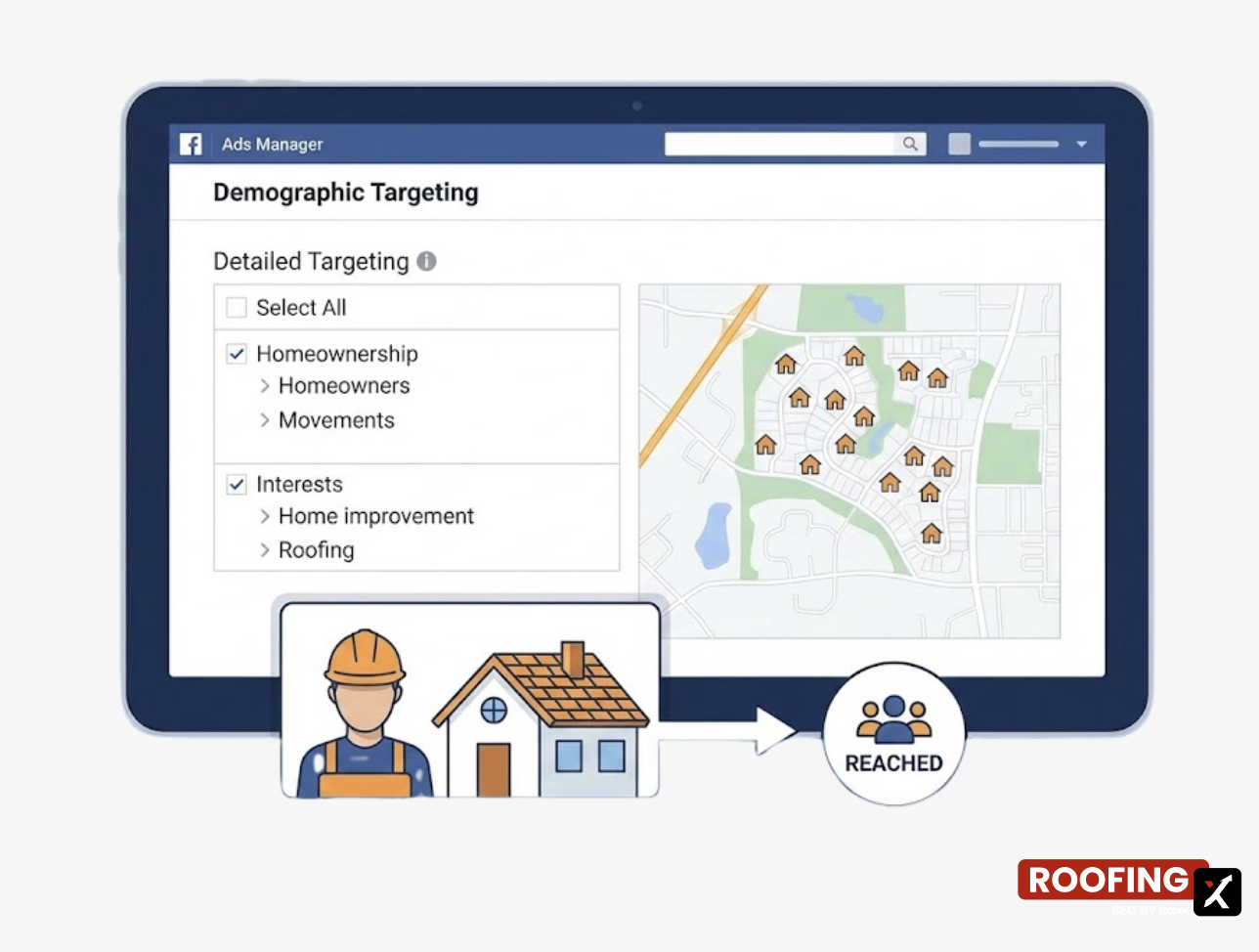
Demographic targeting is your best friend here. In Facebook Ads Manager, audiences can be filtered by age, income, life events, and family status. When you stack several of these filters, you create an audience profile that closely resembles property owners.
Age Ranges that Correlate with Homeownership
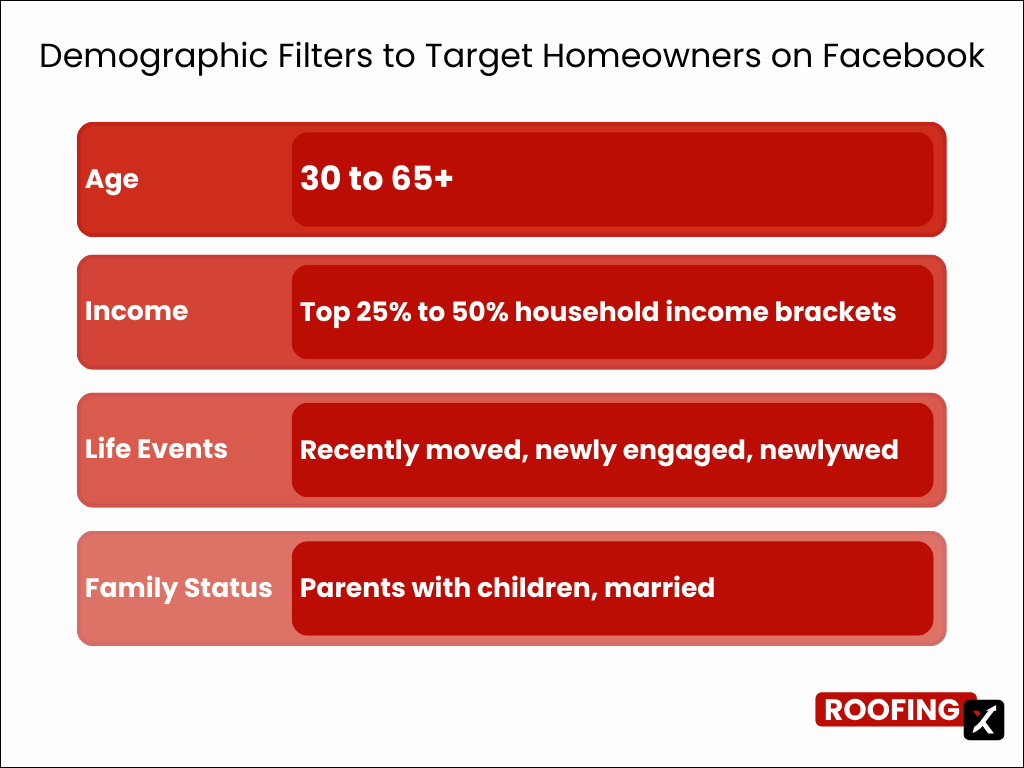
Homeownership rates climb with age. Selecting ages 30 to 65+ in Ads Manager typically captures the majority of property owners in most markets. Younger audiences, particularly 18- to 29-year-olds, tend to rent more frequently, so excluding that age range can help stretch your ad budget.
Income Levels and Financial Behaviors
Facebook offers household-income targeting in select geographic areas. Selecting the top 25%-50% of earners often aligns with property ownership patterns. You can also target financial behaviors, such as premium purchase patterns or investment-related interests.
Life Events and Family Status Signals
Life events are strong signals for homeownership. "Recently moved" catches people who have just purchased a home. Marital status and "parents with children at home" also align well with property ownership, as families often buy rather than rent.
Now you know the first step in how to target homeowners on Facebook is to use the right demographic filters. Here’s a quick reference:
Interest and Behavior Targeting that Find Roofing Leads
Interest targeting in Facebook shows your ads to people based on pages they've liked and content they've engaged with. Behavior targeting tracks purchase patterns and activities. Both help you reach homeowners indirectly, since the direct option is no longer available.
Home Improvement and DIY Interests
People who follow Home Depot, Lowe's, or HGTV typically own property. Renters rarely spend weekends watching home renovation shows or browsing hardware store pages. Selecting home improvement interests narrows your audience to homeowners.
Lifestyle Interests that Signal Homeownership
Gardening, lawn care, and home decor interests are strong indicators of property ownership. Someone researching landscaping or patio furniture probably owns the yard they're improving. Apartment dwellers don't typically engage with this type of content.
Recent Home Buyer Behaviors
Facebook sometimes offers behavioral categories like "likely to move" or "new homeowner." Availability varies by market, but when present, these options are worth testing. Check the detailed targeting section under "behaviors" to see what's available in your area.
Specific interests worth targeting:
- Home Depot, Lowe's, Menards, Ace Hardware
- HGTV, This Old House, DIY Network
- Gardening, landscaping, home renovation, and interior design
Location Targeting for Your Roofing Service Area
Geographic precision matters for roofing businesses. Roofing leads from 50 miles away don't help when you only service a 20-mile radius.

Radius Targeting Around Your Service Location
In Ads Manager, you can drop a pin on your shop or service area and set a mile radius around it. A 15- to 25-mile radius works well for most roofing companies. Tighter radii make sense in dense urban markets where drive times add up quickly.
ZIP Code and Neighborhood Precision Targeting
ZIP code targeting lets you focus on specific neighborhoods. This works well for storm-damage campaigns or areas with older housing stock that may require roof replacements. You can target multiple ZIP codes and exclude others within the same campaign.
How to Exclude Areas You Do Not Service
The exclusion feature prevents wasted spend on unreachable leads. If you service the north side of a city but not the south, exclude those southern ZIP codes. Every dollar spent on leads outside your service area is a dollar lost.
In your line of business, just remember that location is the king, be it local SEO, Google Business Profile optimization, or Facebook targeting.
How to Build Custom Audiences from Your Customer List
Custom audiences are a key piece of how to target homeowners on Facebook, as they let you upload your own data and reach people who already know your company or mirror your ideal customer profile.
Uploading Customer Emails and Phone Numbers
Export customer data from your roofing CRM or job management software. Upload the list to Ads Manager, and Facebook matches it against user profiles. Match rates typically run 30% to 60%, depending on data quality and formatting.
Creating Audiences from Website Visitor Data
This requires the Facebook Pixel (now called the Meta Pixel), a small piece of code installed on your website. The Pixel tracks visitors and lets you show ads to people who have already browsed your site. More on Pixel setup in the retargeting section below.
Building Audiences from Facebook Page Engagement
If you have an active Facebook page, you can create audiences from people who engaged with your posts or videos. This works well for roofers just starting out who don't yet have large email lists.
How to Target Homeowners on Facebook with Lookalike Audiences
A lookalike audience is Facebook's method for identifying new people who resemble your existing customers. You provide a "seed" audience, and Facebook's algorithm finds similar users across the platform.
Creating Lookalikes from Your Best Roofing Customers
Quality matters more than quantity for seed audiences. Use your highest-value customers as the seed, not everyone who ever called. A list of 100 great customers is better than 1,000 random contacts for building an effective lookalike.

Choosing the Right Lookalike Audience Percentage
The percentage slider controls the balance between similarity and reach. A 1% lookalike is most similar to your seed but the smallest in size. A 5%-10% lookalike is larger but less precise. Starting with 1% to 3% tends to work well for roofing campaigns.
How to Retarget Homeowners who Visited Your Website
Retargeting shows ads to people who have already visited your site but didn't convert. These are warm leads who know your company exists. One thing our roofing SEO agency has seen repeatedly is that conversion rates in retargeting campaigns often exceed those in cold-traffic campaigns.
Installing the Facebook Pixel on Your Roofing Website
The Facebook Pixel is a snippet of JavaScript code that you add to your website's header. It tracks visitor behavior and sends that data back to Facebook. Most website platforms, such as WordPress, Wix, and Squarespace, offer simple Pixel installation options in their settings.
Building Retargeting Audiences by Page Visited
You can create separate audiences based on which pages people visited. Someone who viewed your roof replacement page gets different messaging than someone who browsed roof repairs. Setting time windows of 30 to 90 days tends to capture leads while they're still in the decision-making process.
Retargeting Ad Messaging that Converts
Retargeting ads differ from cold ads because the audience already knows you. Skip the introduction and focus on urgency, social proof, and direct calls to action that convert warm visitors into booked jobs. "Still thinking about that roof?" works better than "We're the best roofers in town."
Testing and optimizing your roofing Facebook campaigns
Your first campaign is an experiment. You’re still learning how to target homeowners on Facebook. Expect to adjust targeting, creative, and budget based on the data.
How to A/B Test Audiences and Ad Creative
Test one variable at a time. Run the same ad to two different audiences, or run two different ads to the same audience. Facebook's built-in A/B test feature makes setting it up straightforward.

Budget Allocation and Scaling Winning Campaigns
Once you identify winning ad sets, shift budget toward them. Scale gradually, increasing spend by 20%-30% at a time. Sudden budget jumps can reset the learning phase and hurt performance.
Metrics that Matter for Roofing Lead Generation
Focus on cost per lead and lead quality, not vanity metrics like impressions or reach. A campaign with 10,000 impressions is meaningless if no one calls.
- Cost Per Lead (CPL): What you pay for each form submission
- Lead Quality: Do leads answer the phone? Are they qualified?
- Cost Per Acquisition: What you pay for an actual booked job
That’s why you should ensure your campaign addresses the needs and questions roofing service customers ask.
How Facebook Ads Work with Your Roofing SEO Strategy
Facebook ads interrupt homeowners as they scroll through their feeds. Roofing SEO process makes sure a roofing website captures people actively searching for roofers. Both channels work together when combined properly.
Retargeting website visitors from organic search combines the best of both approaches. Someone finds you on Google, browses your site, and then sees your Facebook ad later that week. That multi-touch approach builds familiarity and trust over time, supporting your roofing reputation management.
Roofers who rely on one channel leave money on the table. A strong Google Business Profile, plus local SEO, plus Facebook ads, creates multiple lead sources and helps you scale your roofing business. When one channel slows down, others pick up the slack.
Get More Roofing Jobs from Your Facebook Ad Spend
Targeting is only part of the equation. The real goal is to book jobs, not just generate leads. A hundred leads that don't convert cost you money and time.
If you’re serious about how to target homeowners on Facebook, test your targeting, refine your creative, and track what actually turns into revenue. Combine Facebook ads with a strong SEO presence and a well-optimized Google Business Profile for the best results.
Contact us to learn how your roofing company can generate more qualified leads through paid and organic channels.
FAQs about targeting homeowners on Facebook for roofers
How much should a roofing company budget for Facebook ads monthly?
The budget depends on your market size and level of competition. Starting with enough to gather meaningful data, typically $500 to $1,500 per month, allows for testing. Scale based on results once you identify winning campaigns.
How long before Facebook ads generate roofing leads?
The learning phase takes about a week. Most roofers see initial leads within two to three weeks if targeting and creative are solid. Patience during the learning phase pays off.
Across other channels, such as roofing SEO, we’ve seen a 100% increase in roofing leads in just a couple of months. Read our case study on a Michigan-based roofing company to see how.
Can roofing companies target commercial property owners on Facebook?
Commercial targeting is harder than residential. Try targeting by job title (property manager, facility manager, building owner) or business page engagement. Homeowner tactics don't translate directly to commercials.
Roofing trade shows and SEO are better discovery channels for commercial clients.
How do roofers run Facebook ads quickly after storm damage hits?
Prepare campaigns in advance with storm-specific creative and save them as drafts. When storms hit your service area, activate with tight geographic targeting around affected ZIP codes.


.webp)