



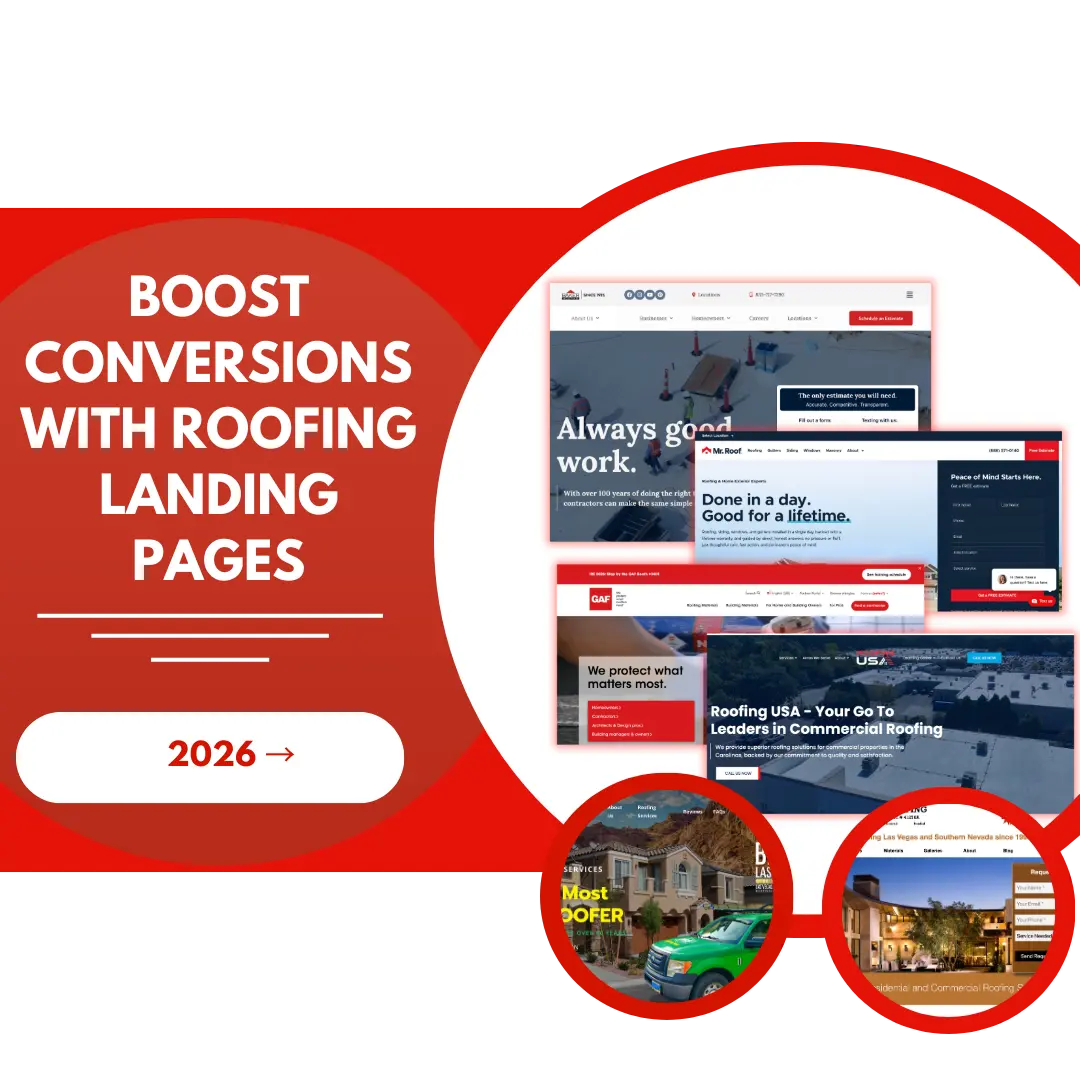
Sending paid traffic to a homepage is one of the fastest ways to inflate roofing lead costs. Ads usually aren’t the issue. The landing experience is.
A dedicated roofing landing page is built for one purpose: turning clicks into calls and form fills.
I’ve worked with 160+ roofing companies, and in this guide, I’ll share my experience and break down what makes roofing landing pages convert. You’ll find the 10 changes that consistently lower cost per lead, and the mistakes that quietly kill lead flow every week.
What Is a Roofing Landing Page?

A roofing landing page is a single-purpose page built to generate a lead. Nothing more. Its job is to get a homeowner to call you, submit a form, or request an estimate without distractions.
Unlike a homepage, a landing page doesn’t explain your company's story or list every service you offer. It removes navigation, secondary links, and competing calls to action, giving visitors a single clear next step.
Here’s how it works in practice:
Someone searches “storm damage roofer near me.” They land on a page focused entirely on storm damage: urgency, insurance help, and how to get an inspection fast.
The page matches the intent that brought them there.
There are four main roofing landing page types:
- Paid Ad Landing Pages: Explicitly built for Google Ads or Facebook/Meta Ads, matching the ad copy and keyword intent closely.
- Local Service Pages: Targeting a specific city or service area for organic local roofing SEO traffic.
- Storm Damage Pages: Designed to capture high-intent, time-sensitive leads after hail, wind, or severe weather.
- Service-Specific Pages: Focused on one offer only: repairs, replacement, or commercial roofing.
No matter the type, one rule applies: Each roofing landing page has one goal and one path forward. No distractions. Just a clear next step.
Why Your Roofing Company Needs Dedicated Landing Pages
Sending paid traffic to your homepage is like pouring water into a leaky bucket: visitors click an ad, scan the page, navigate to menus, About pages, blogs, and service lists, and then leave without calling.
Dedicated landing pages fix this.
When someone clicks an ad for “emergency roof repair in Austin,” they should land on a page about emergency roof repair in Austin, and not a general homepage trying to speak to everyone at once. This focus matters for more than conversions.
Landing pages also:
- Help you rank for [service] + [city] searches
- Improve Google Ads Quality Score when the page matches the ad copy
- Lower cost per click by increasing relevance and engagement
I’ve seen roofing companies double their conversion rates simply by switching from homepage traffic to dedicated landing pages! Same Google Ads spend. More leads.
And there’s a compounding effect.
Each properly built landing page targets a new set of high-intent roofing keywords. That means more visibility, more qualified traffic, and stronger overall site performance over time.
See how we increased a roofing website’s traffic by ~6000% in just 1.5 months in our case study on Forte Roofing.
10 Ways to Boost Conversions on Your Roofing Landing Page
1. Define One Clear Conversion Goal
Let’s remember the rule: every high-performing roofing landing page has one page, one goal.
Decide what you want the visitor to do, then build everything around that action. For roofers, that’s usually:
- Phone calls for emergency work
- Form submissions for estimates
- Scheduled inspections
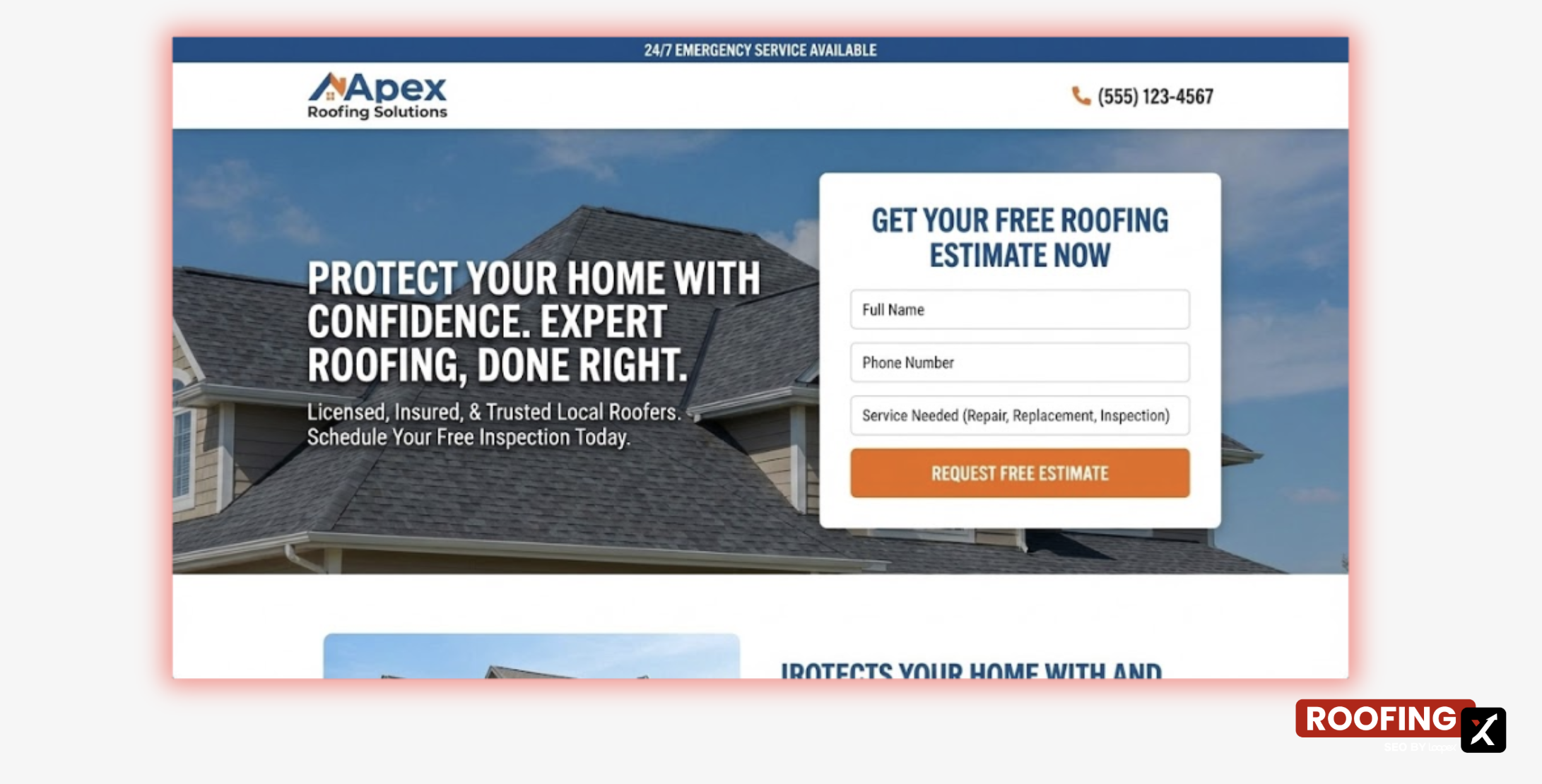
Choose one. Then remove anything that competes with it.
If calls are the goal, make your phone number impossible to miss.
If form fills are the goal, keep the form short and place it above the fold, so visitors see it immediately.
2. Write Headlines That Reflect Homeowner Urgency
Visitors decide within seconds whether to stay or leave based on your headline.
Generic headlines like “Quality Roofing Services” don’t help. They could describe any roofer, anywhere. This violates all roofing lead-generation rules.
Strong headlines speak to the problem, the location, or the urgency.
Weak headlines
- Best Roofer in Town
- Quality Work, Fair Prices
- Professional Roofing Services
Stronger headlines
- Roof Leaking? Same-Day Repairs in Austin
- Storm Damage? We Handle Your Insurance Claim
- Get Your Free Roof Inspection Before Winter

See the pattern? The best headlines sound like what the homeowner is already thinking.
3. Match Your Landing Page to The Traffic Source
If someone clicks an ad that says “Free Roof Inspection in Phoenix,” your landing page should say exactly that.
The same applies to organic traffic. If a page ranks for “hail damage roof repair Denver,” the content should focus on hail damage (and the Denver area), specifically.
When messaging doesn’t match expectations, visitors leave.
4. Use Benefit-Driven Copy that Addresses Real Pain Points
Homeowners don’t care about your equipment or how long you’ve been in business. They care about:
- Stopping the leak
- Dealing with insurance
- Getting the problem fixed quickly
That’s why benefits outperform features.
A good test I use: after every sentence, ask “So what?” If the answer isn’t obvious to a homeowner, rewrite it.
5. Add Trust Signals that Prove Your Credibility
Roofing is a high-trust decision. You’re asking homeowners to let strangers work on one of their biggest assets. They want proof before they call.
Trust signals that work well on roofing landing pages include:
- Google reviews with star ratings (not just a link)
- Manufacturer certifications like GAF, Owens Corning, or CertainTeed
- BBB accreditation
- State license numbers
- Proof of insurance, including liability and workers’ comp
Place these near your call-to-action. When someone is about to submit a form, a visible 4.9-star rating can be the final push.

6. Design a Layout that Supports Conversions
Your layout either guides visitors forward or pulls them away. I’d recommend keeping it simple:
- Remove main navigation. Every link is an exit.
- Put CTAs above the fold. Don’t make visitors search.
- Use visual hierarchy. Headlines, phone numbers, and buttons should stand out.
- Keep it scannable. Short paragraphs, bullets, and white space matter.
When someone lands on your page, the next step should be obvious within seconds.
7. Use Calls-to-Action That Invite Action
This is the conversion step. Weak CTAs like “Submit” or “Contact Us” don’t motivate anyone. Strong CTAs tell visitors exactly what they’ll get.
CTAs that work well for roofers, based on my experience:
- Get My Free Estimate
- Schedule My Inspection
- Call Now for Same-Day Service
- Check If I Qualify for Insurance Coverage
Tip: Make phone numbers tap-to-call on mobile.
Most homeowners search on their phones, often while standing outside and assessing damage. Keep forms short, too: name, phone, address, and a brief description are enough.
8. Show Real Project Photos and Video
Before-and-after photos build trust faster than copy ever will. Homeowners want to see real work. Not stock images. The most effective visuals include:
- Before-and-after photos from local jobs
- Drone footage showing full roof scope
- Short video testimonials
- Photos of your crew on-site
Avoid stock photography entirely. It’s easy to spot, and it hurts credibility.

9. Build for Mobile-First Speed and Performance
Since roofing searches occur mostly on mobile devices, especially during emergencies, speed matters, if your page takes five seconds to load, many visitors will leave before they see anything.
Quick mobile checklist:
- Test the page on real phones
- Compress images properly
- Make buttons easy to tap
- Ensure forms work smoothly on touchscreens
- Confirm your phone number is tap-to-call
Fast pages convert better. It’s that simple.

10. Optimize for Local Search and Service Areas
Landing pages and local SEO work best together. A well-built local landing page can rank for “[service] + [city]” searches and generate organic leads without ad spend.
Focus on:
- Location-specific keywords in headlines and body copy
- Embedded Google Maps showing your service area
- Consistent NAP matching your Google Business Profile
- Local references like neighborhoods, weather patterns, or landmarks
We’ve helped roofing companies rank for dozens of local keywords by creating one landing page per service area, each tailored to that specific city.
Plus, this supports your AI SEO for roofers, improving your chances of appearing in ChatGPT or AI Overview!
Common Roofing Landing Page Mistakes That Kill Conversions
After reviewing hundreds of roofing landing pages, the same problems recur.

1. Too Much Navigation
The main site navigation provides visitors with exit paths. They click About, Services, or Blog and never return to convert.
A landing page should limit choices. Fewer links mean fewer escapes.
2. Generic Copy That Sounds Like Every Roofer
“Quality work at affordable prices” doesn’t persuade anyone. Every roofing company says it.
Effective landing pages use specific, local, benefit-driven language that answers one question clearly: Why should I call you instead of the next roofer?
Imagine speaking with a real homeowner and answering their roofing questions.
3. Slow Load Times (Especially on Mobile)
Heavy images, uncompressed files, and bloated scripts kill conversions.
If your page takes more than three seconds to load, many visitors leave before reading a single line, especially on mobile, where most roofing traffic comes from. That’s why the best roofing SEO companies will focus on your technical SEO first.
4. Weak or Hidden Calls-to-Action
If visitors have to search for how to contact you, they won’t. Your phone number and primary form should appear above the fold and repeat naturally throughout the page.
5. No Trust Signals
A landing page without proof feels risky. Homeowners want reassurance before they call:
- Reviews
- Ratings
- Local photos
- Certifications
Anything related to your roofing reputation management should be here. Without trust elements, hesitation wins, and the lead is lost.
Build Roofing Landing Pages That Generate Real Jobs
Roofing landing pages have a clear goal: generating phone calls from homeowners who need roofing work done.
If you want help building landing pages that convert for your roofing company, contact us! We’ve done it for 160+ roofers just like you. We'll analyze your current setup and show you exactly where the opportunities are.
FAQs
How long should a roofing landing page be?
Length depends on your traffic source. Paid ad landing pages typically work best when short and focused, around 500-800 words. Local SEO pages benefit from more detailed content, often 1,000-1,500 words, because they answer the questions homeowners are searching for.
Should I create separate landing pages for each roofing service?
Yes. Separate pages for roof repair, replacement, storm damage, and commercial roofing allow you to match visitor intent more precisely. Each service attracts different homeowners with different needs and urgency levels.
Can I use the same landing page for paid ads and organic traffic?
You can, but dedicated pages for each traffic source typically perform better. Paid ad visitors expect messaging that matches the ad they clicked. Organic visitors may need more educational content since they're often earlier in their research.
How often should I update my roofing landing page?
Review performance monthly and make updates based on conversion data. Refresh testimonials and project photos quarterly. Update seasonal messaging for storm season, winter prep, or spring inspections.

.webp)