



Local SEO for a roofing company usually shows the first Google Maps movement and first organic calls in 60 to 90 days. Page 1 rankings for core "service + city" searches take 4 to 6 months. Competitive metro terms and a steady, compounding flow of leads take 6 to 12 months.
Where you land in that range depends on three things: what you're starting with (website, Google Business Profile, reviews), how crowded your market is, and which services you want to rank for.
Below you'll find the month-by-month timeline we work to as a roofing SEO company, the real timelines from four of our roofing campaigns (3 months for the fastest, 9 for the hardest), and what speeds things up or slows them down in 2026.
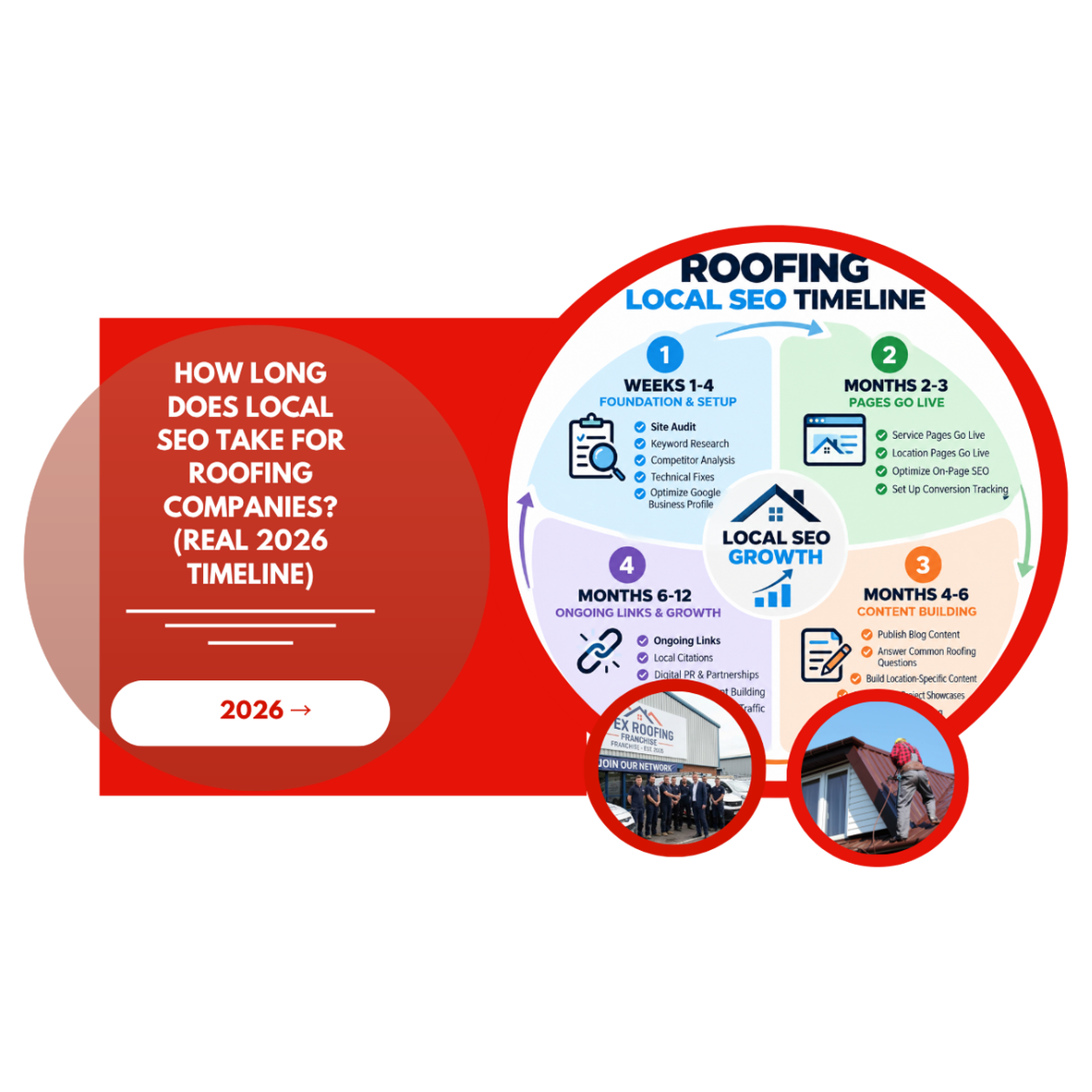
Roofing Local SEO Timeline: What Happens Month by Month
Local SEO for roofers moves in four stages. Each one has its own sign of progress, and knowing which stage you're in stops you from judging month 2 by month 6 standards.
Results show up in a chain - impressions first, then clicks, then calls, then booked jobs. In the first few months, you'll see the early links of that chain long before the last one. That's normal, and it's exactly why you should track all four, not just signed contracts.
If you want the full breakdown behind each stage, our step-by-step roofing SEO guide covers the work itself. This article is about the timeline itself.
Map Pack, Organic Rankings and AI Answers Timelines
The Google Map Pack usually moves first, organic website rankings take longer, and AI answers mostly follow both.
Google Map Pack: 60-90 Days for First Movement
Map rankings run mostly on your Google Business Profile: the right categories and services, your distance to the searcher, and your reviews. Those are signals you can fix in days through GMP optimization for roofing. It's also where the calls are. Someone searching "roof leak repair near me" taps a map listing and calls.
Organic Rankings: 4-6 Months for Core Terms
Your website's blue-link rankings need pages Google can trust: dedicated service pages, real city pages, and links from other sites. Google needs time to crawl those pages, test them against competitors, and build confidence. That's why organic rankings lag the map, especially for broad terms like "roofing company [city]."
Of course, this stage can show results faster depending on your local competition and the target keywords we choose.
AI Mode, AI Overviews, and Ask Maps Follow the First Two
In testing by Human Level, AI Mode sometimes listed up to ten local businesses, and the businesses holding the top three Map Pack spots usually showed up there too. This means that AI answers pull from the same profile, reviews, and website signals your local SEO is already building.
So there's no separate "AI clock" to wait on. Strong Map Pack and organic work carries into AI answers. The extra piece is making sure AI tools can read your site and find your business mentioned elsewhere, which is what our AI search optimization for roofers focuses on.
Real Roofing SEO Timelines: 4 Campaigns, 3 to 9 Months
In our own roofing campaigns, clear results landed anywhere between month 3 and month 9. The starting point decided where each one fell. Here's what that looked like in practice.
Two things stand out from these campaigns.
- A flat first six weeks is normal. The mid-sized California contractor's traffic didn't move at all for the first 1.5 months. Three months in, its pages were holding the top 10. If that owner had judged the campaign at week six, they'd have quit right before it worked.
- Fixing what's broken is fastest. Building authority from nothing, in a crowded market, is slowest. The first California roofer already had a site Google trusted; it just had mismatched business info and missing location pages. Fixing that took 3 months. The Texas roofer had almost no authority and was competing against big out-of-town firms after every storm. That took 9 months, and it was still worth it: leads more than quadrupled.
So, the clear answer to how long local SEO takes for roofing companies is that it depends on which of these four roofers you look most like.
What Decides How Long Local SEO Takes for Your Roofing Company
4 things shape your timeline: your starting point (1), how crowded your market is (2), which services you're targeting (3), and how your reviews compare with the roofers around you (4).
1. Your Starting Point
- Established site with fixable problems: fastest. Google already knows you; you're removing what's holding you back.
- New or near-zero-authority site: slower. Google needs time and outside signals (links, reviews, mentions) before it trusts a new domain.
- Site damaged by past shortcuts: slowest. Spammy links, keyword-stuffed GBP names, or copy-paste city pages have to be cleaned up before growth starts. If you've had SEO work done before, tell your new agency up front. A proper roofing SEO audit finds this in week one instead of month four.
2. Your Market and Competition
A town with a dozen roofers is a different fight than a metro with a hundred. In a small market, you might hold a Map Pack spot within 2 to 3 months. In a dense metro, where established roofers have years of reviews and links, expect 6 to 12 months for the broad terms.
Storm markets add a twist. After a hail or wind event, out-of-area companies with strong websites can flood local results, as our Texas client saw with Houston and Dallas firms. Local reviews and real local pages help you hold your ground against them. You can gauge demand and competition for your area with our free roofing keyword explorer.
3. The Services You Want to Rank For
- Repair, inspection, and leak searches often rank first. They're specific, and fewer competitors build dedicated pages for them.
- "Roof replacement [city]" and "roofing company [city]" take the longest. Every roofer wants them.
- Commercial roofing has lower search volume but often weaker competition, so a well-built page can rank faster than you'd expect (more in our commercial roofing leads guide).
- Storm and insurance pages need to rank before the storm. Demand spikes for days, not months.
4. Your Reviews Compared with Local Competitors
In a 2026 consumer survey, 41% of consumers said they always read reviews (up from 29% in 2025), and 31% said they'll only use businesses rated 4.5 stars or higher (up from 17%). Roofing is no exception. In a 2026 homeowner survey, 62% of homeowners called online reviews very or extremely important to their decision.
Reviews are the one factor you can't rush. A roofer finishing 15 jobs a month can't jump from 20 to 150 reviews in a quarter, so if your competitors are far ahead, reviews will set your real timeline. Our roofing reputation management guide covers how to build that flow, and we help you navigate this through our roofing-specific reputation management services.
How to Speed Up Local SEO: Fast Levers vs Slow Levers
To shorten your timeline, pull every fast lever in month one and start the slow ones on day one.
The ranking signals below come from a detailed local search ranking factors report, a survey of 47 local search experts scoring 187 factors.
| Speed | Lever | Why it matters |
|---|---|---|
| Weeks | GBP primary and secondary categories | Primary category ranked #1 for Map Pack impact |
| Weeks | GBP predefined services (roof repair, replacement, inspection, etc.) | Ranked #22, and Whitespark confirmed the effect in its own testing |
| Weeks | Accurate business hours | "Open at time of search" ranked #5. Closed businesses get pushed down |
| Weeks | GBP linked to the right landing page, matching name, address, and phone | Mismatches confuse Google and weaken map rankings |
| 1-3 months | One dedicated page per service |