



.png)
A roofing website needs 10 core page types to rank locally and convert visitors into leads: a homepage, individual service pages, service area/city pages, an about page, a reviews page, a project gallery, a contact/estimate page, an FAQ page, a blog, and, for larger companies, separate residential vs. commercial pages. Skip any of these and you're leaving both rankings and leads on the table.
Below, I'll break down exactly what each page needs to include, why it matters for SEO, and what a good example looks like. This is the same structure we use when we rebuild roofing sites at our roofing SEO company.
We used it recently to restructure a website for a roofer and took the site from near-zero visibility to a 200% increase in organic leads in six weeks. I’ll talk about it more below.
Why One "Services" Page Isn't Enough
The single biggest mistake roofing websites make is cramming every service - repairs, replacements, installations, inspections - onto one generic "Services" page. It feels efficient, but it works against you.
Search engines rank pages for specific queries. A single services page might rank for "roofing services," but it has almost no shot at ranking for "roof repair" and "roof replacement" and "emergency roofing" at the same time - those are different searches with different intent, and Google wants a page that's clearly built to answer each one.
Split the content into dedicated pages, and each one gets a real shot at ranking for its own set of terms. This is the core idea behind on-page SEO for roofers: one page, one clear topic, one clear job to do.
Now, with this in mind, let’s build your top 10 pages for a roofing contractor website.
The 10 Pages Your Roofing Website Needs
1. Homepage
Your homepage is the hub search engines and visitors both land on first. It needs to say - within the first screen, no scrolling - who you are, what you do, where you work, and how to reach you.
What it needs:
- Business name and a clear H1 (e.g., "Roofing Contractor in Atlanta | Roof Repair & Replacement")
- Core services listed with links to their dedicated pages
- Phone number and a visible CTA (call, get a quote, schedule inspection)
- Primary service area named explicitly!
This last one is a really important local signal. Google and your visitors both need that information immediately as they land.
2. Individual Service Pages
Build one dedicated page per service. If you offer roof repair, replacement, installation, and inspections, that's four pages minimum.
What it needs:
- A clear H1 with the service and location (e.g., "Roof Repair in Austin, TX")
- Original content describing the service, process, and what homeowners can expect
- Pricing guidance or a clear path to get a quote
- Internal links to related pages (gallery, reviews, FAQ)
Example titles:
- Roof Repair
- Roof Replacement
- Roof Installation
- Roof Inspection
And do yourself a favor and don’t duplicate boilerplate text across service pages (copy language from a competitor)! I’ve seen this miskate too many times in roofing websites. Original content matters here more than almost anywhere else on the site.
And if writing unique, keyword-aligned copy for every service and city isn't something your team has time for, this is exactly what our content writing for roofers is built to handle.
3. Residential vs. Commercial Roofing Pages
If you serve both markets, split them. Residential and commercial roofing customers search differently, buy differently, and care about different things. For example, a homeowner generally wants to know about warranties and curb appeal, a property manager wants to know about TPO systems and downtime. They also search on a different schedule, becasue propery managers plan beforehand (as a general scheduleing rule), but a homeowner might look for you in an emergency.
So, I generally recommend to give it its own page if commercial work makes up a meaningful share of your revenue, or if you specialize in a commercial roofing system (TPO, EPDM, built-up roofing). Smaller residential-only companies can skip this and fold the distinction into their main service pages instead.
4. Service Area / Location Pages
This is where most roofing websites either win or lose local search. You need one page per city, town, or service area you work in.
What it needs:
- A unique H1 like "Roof Repair in [City Name]"
- Local landmarks, neighborhoods, or context that shows you work there
- Local reviews or project photos from that area if you have them
- A map or service radius reference
But I need to prepare you for this risky part as well. Location pages are the easiest page type to get penalized for thin or duplicate content. If your 15 city pages are the same paragraph with the city name swapped, Google will notice, and it can hurt rankings across the whole site. Each page needs genuinely distinct, locally relevant content - this is a large part of what we handle in our Google Maps optimization and local SEO work, and it's covered in more depth in our guide on how to do roofing SEO.
5. About Us Page
This page does more SEO work than most roofers give it credit for. It's your primary opportunity to build E-E-A-T (Experience, Expertise, Authoritativeness, Trustworthiness) - a set of signals Google explicitly looks for, especially in trades where trust decides the sale.
What it needs:
- Company history and years in business
- Licensing, insurance, and certifications (be specific - license numbers matter)
- Team bios, especially for owners or lead installers
- Any manufacturer certifications (GAF Master Elite, Owens Corning Preferred, etc.)
6. Reviews / Testimonials Page
Google reviews live on your Google Business Profile, but you also need proof on your own site - a dedicated page (not just a homepage widget!) that visitors and search engines can find and reference.
What it needs:
- Written testimonials, ideally tied to specific jobs or services
- Star ratings with review schema markup so they can appear in search results
- Video testimonials if you have them
- A mix of recent and long-standing reviews to show consistency
Managing and growing this consistently is its own discipline - we cover the full process in our roofing reputation management guide.
7. Project Gallery / Portfolio
Homeowners want to see your work before they call, so a gallery page with before-and-after photos does double magic: it builds trust with visitors and gives you a legitimate reason to optimize a batch of images for search.
What it needs:
- Before/after photo pairs organized by service or material type
- Descriptive file names and alt text (e.g., "asphalt-shingle-roof-replacement-atlanta.jpg," not "IMG_4521.jpg")
- Captions noting the location, material, and scope of work
For inspiration on how other roofing companies structure this, our breakdown of roofing website examples is worth a look.
8. Contact / Free Estimate Page
This is your highest-intent conversion page and the one visitors reach when they're ready to act. It needs to make taking that action as frictionless as possible.
What it needs:
- A short quote/estimate form (name, phone, service needed, address)
- Click-to-call phone number
- Embedded Google Map with your pin
- Business hours and emergency contact info if you offer 24/7 service
If this page isn't converting the traffic it gets, the fix usually is the page itself. That's the exact problem our conversion rate optimization is built to solve, and it's a big part of what moved the needle for Forte Roofing.
9. FAQ Page
An FAQ page targets the long-tail, conversational questions homeowners actually type into Google - "how long does a roof replacement take," "does insurance cover roof leaks," "how much does a new roof cost." These questions also have real potential to show up in AI-generated answers and featured snippets, since they're already structured as direct Q&A.
What it needs:
- 8-15 real questions your customers actually ask
- Direct, specific answers (2-4 sentences each)
- FAQ schema markup so search engines and AI tools can parse the Q&A structure
This page has become more important as more homeowners start their search in AI tools instead of traditional search. We go deeper on this in our guide to AI SEO for roofers.
10. Blog / Resource Section
A blog isn't optional if you want to rank for anything beyond your core service and location terms. It's also how you capture informational searches (people researching) and turn them into future customers.
What it needs:
- Seasonal content (storm prep, winter roof maintenance, spring inspections)
- Comparison content (metal vs. asphalt shingles, repair vs. replace)
- Consistent internal linking back to your service and location pages
If you're not sure what to write about, our roofing blog ideas and roofing SEO keywords guides are a good starting point, and our roofing keyword explorer tool can help you find what homeowners in your area are searching for.
Example Roofing Website Sitemap
Here's how these 10 page types typically fit into a site's navigation and URL structure:
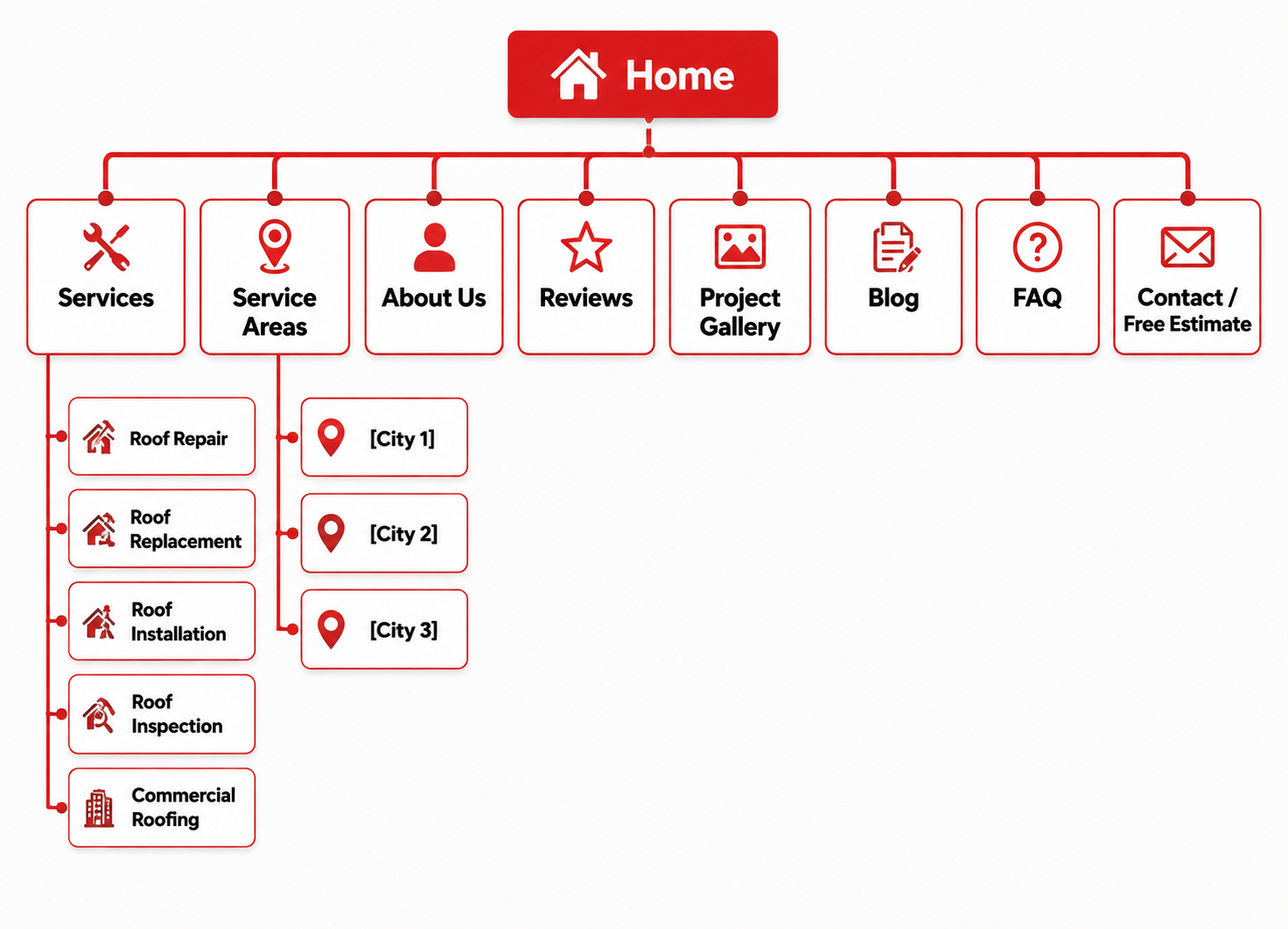
Notice the shape: services and locations sit as parent categories with their own subpages, everything links back to Contact, and nothing is buried more than two clicks from the homepage.
That flat, logical structure is exactly what we rebuilt for our client, Forte Roofing - organizing the site around their core services and Boca Raton-area location pages, with a central services hub tying it all together - which is a big part of why their domain rating jumped from 4 to 10 in about two months. You can see the full breakdown in the Forte Roofing case study.
How Many Pages Should a Roofing Website Have Total?
Use this simple formula: (number of core services) × (number of service areas) + your core pages (home, about, contact, reviews, gallery, FAQ, blog index).
For example, a roofer offering 4 services across 5 cities would need roughly 20 service-area pages (4 times 5) plus 7 core pages - around 27 pages minimum, before counting blog posts.
It's tempting to cut corners here by combining cities or services, but each combination you skip is a search query you're not competing for.
Common Mistakes That Hurt Roofing Website SEO
- One generic services page instead of dedicated pages per service
- Duplicate or thin location pages — swapping the city name without changing anything else
- Missing NAP consistency - your name, address, and phone number need to match exactly across your site, Google Business Profile, and directories
- No dedicated contact/estimate page - burying your form on the homepage or a generic "Contact" page with no clear CTA
- Slow load times - especially from unoptimized gallery images, which is often the first thing a technical SEO audit catches
If you're not sure where your current site stands on any of this, a free roofing SEO audit is the fastest way to find out before you start restructuring pages. Just contact us, and we’ll help your website reach the top of the search like we did for dozens of others.
Frequently Asked Questions
Does a roofing company need a separate page for every city it serves?
Yes, if you actively want to rank in that city's local search results. A dedicated page with unique, locally relevant content signals to Google that you genuinely serve that area - a single "Service Areas" page listing cities in a paragraph won't compete with a dedicated page from a local competitor.
Should residential and commercial roofing be on the same page?
Only if commercial work is a small part of your business. If you do meaningful commercial volume, split them - the search intent, materials, and messaging are different enough that combining them weakens both.
What's the difference between a service page and a location page?
A service page targets what you do ("roof repair"); a location page targets where you do it ("roof repair in Denver"). Ideally, your highest-value combinations - top services in top cities - get their own dedicated page combining both.
Does a roofing website need a blog to rank?
If you only want to rank for your core service and city terms, technically no. But a blog is how you capture informational searches, build topical authority, and create internal linking opportunities - most roofing companies that skip it plateau in rankings faster.
What should be on a roofing contact page besides a phone number?
A short quote form, an embedded map, business hours, and - if you offer it - a clear note on emergency or same-day service. The goal is removing every unnecessary step between "I need a roofer" and "I just requested a quote."

.webp)