



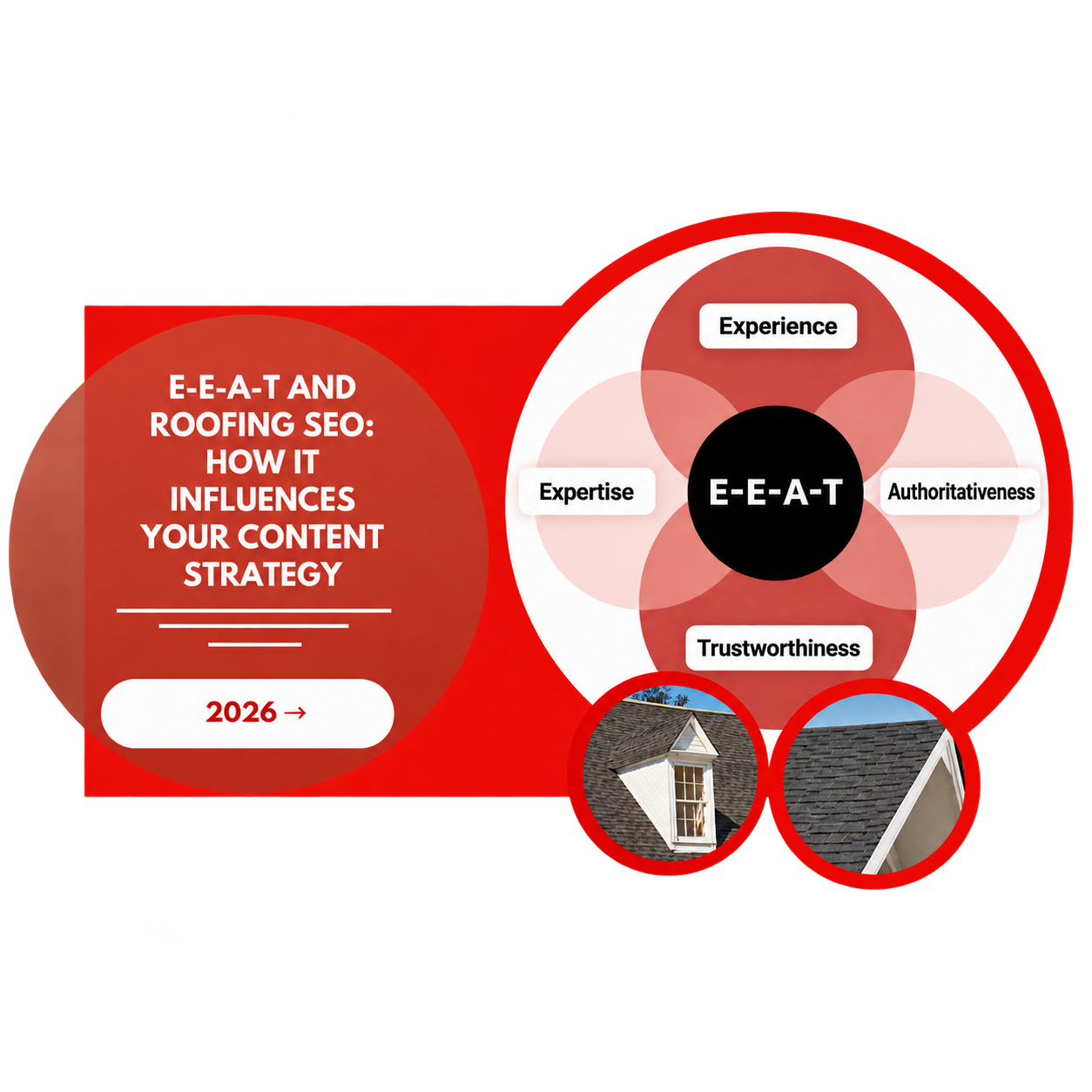
E-E-A-T stands for Experience, Expertise, Authoritativeness, and Trust. It is the standard Google uses to judge whether a page deserves to be shown to searchers. For roofing companies, E-E-A-T means your website has to prove that real, licensed crews did real local jobs.
That shapes your whole roofing content strategy: what you publish, who you name as the author, which photos you use, and how you handle reviews and AI-written drafts.
The timing matters. Google just finished its September 2026 spam update, which ran from September 24 to October 8. The last broad core update was in May, and core updates are when weak trust signals turn into lost rankings and lost calls. On October 1, Google also rewrote its guidance on AI content, and that change hits roofers who mass-produce AI pages.
We have worked only with roofers since 2018. This guide covers what E-E-A-T means for a roofing business, what our team changes first on client sites, and how to tell whether it is working.
What Does E-E-A-T Mean for a Roofing Company
E-E-A-T comes from Google's Search Quality Rater Guidelines. Each letter asks a question a homeowner already asks before hiring a roofer:
Trust is the one that carries the others. The guidelines state plainly that an untrustworthy page has low E-E-A-T no matter how experienced or expert it looks.
Is E-E-A-T a Ranking Factor?
Not directly. There is no E-E-A-T score in Google's algorithm. Google uses outside search quality raters to grade results against these guidelines, and those grades help Google test and improve its ranking systems.
So why does it matter? Because the signals that make a page score well with raters are the same ones Google's systems are built to reward: original content, clear ownership, a solid reputation and accurate information. In our experience across roofing sites, pages with strong trust signals are the ones that hold their positions through core updates.
Is Roofing a YMYL Topic?
Roofing touches YMYL ("Your Money or Your Life") territory. The guidelines give the strictest scrutiny to topics that affect people's safety and financial security, and a roof is both: a five-figure purchase that keeps a family dry and safe. Google does not list roofing by name, but treats your content as if the bar is high, because for the homeowner it is.
One accuracy note, since you will see claims online: the current rater guidelines are still the September 2025 edition.
Why a 20-Year Roofer Gets Outranked by a 2-Year-Old Company
Google can only rank what it can read. A veteran company with stock photos, an "Admin" byline and no project records gives Google nothing to verify. A newer roofer whose site documents every job, names the owner and shows a license number gives it plenty.
We saw this with a mid-sized Florida roofing company. They had two years of solid operations but a Domain Rating of 2 and zero organic leads. Google barely knew they existed. After we fixed the technical and local signals, optimized their re-roofing and post-hurricane service pages, and built 25 to 40 quality links a month, they reached positions 1 to 4 for local Florida searches within four months. Leads from high-value services grew 190%.
So, stop describing roofing and start documenting your roofing.
Experience: Show the Jobs
Experience is the easiest E-E-A-T signal for a roofer to win, because you already have it.
This is what to add to your roofing site:
- Original project photos. Before, during and after shots from real jobs, with the town or neighborhood in the caption. Drone shots of full replacements work well.
- Short crew videos. A 60-second walkthrough of storm damage on a real roof beats a 1,500-word generic article.
- Dated job write-ups. "March 2026, Mesa: replaced a 22-year-old tile roof after monsoon damage" tells Google and homeowners something no competitor can copy.
- Case-study-style service pages. Use this structure: the problem, what the crew found, what you installed, the result, and the homeowner's review.
Rewrite generic topics into experience topics:
Here’s a tip our content team uses on every roofing article - the writer doesn't need to have been on the roof, but someone who was must feed the article. A 10-minute call with the project manager gives you the specifics (materials, quirks, timelines, local conditions) that make content impossible to fake.
If you need ideas to start from, our list of roofing blog ideas works well once you add your own job data to each topic.
Expertise: Put a Licensed Roofer's Name on Your Content
Expertise answers the question "who says so?" On a roofing site, the answer should be a real person with field credentials.
This is what to add to your roofing site:
- Author or reviewer bios. Name the owner, project manager or licensed roofer who wrote or checked each article. Include years in the field, license type and number, manufacturer training, and a photo.
- A "Reviewed by" line on technical pages. Insurance claims, material comparisons and code questions especially.
- Person and Organization schema that connects the author to your company. Our guide to schema markup for roofing websites covers which types matter.
- Precise, local technical detail. Wind-uplift ratings for coastal codes, ice and water shield requirements in snow markets, underlayment choices, permit rules, and what a manufacturer warranty covers.
Homeowners care about this as much as Google does. In a 2026 homeowner survey, 46% said that choosing between two roofers comes down to proven experience and roofing-specific certifications.
Expertise also sits in your service pages. Each core service deserves its own page written with that level of detail. That is the backbone of our on-page SEO for roofers.
Authoritativeness: Get the Right Sites to Vouch for You
Authority is what others say about you. For roofers, the strongest signals are:
- Manufacturer certifications such as GAF Master Elite or Owens Corning Preferred Contractor, shown on your site and linked to your listing on the manufacturer's contractor locator.
- Local press and community mentions: storm-response quotes, sponsorships, Chamber of Commerce and trade association listings.
- Relevant backlinks from local news, regional home improvement publications and roofing industry sites.
- Topical depth on your own site: a pillar page (for example, roof replacement) linked to dedicated material, service and city pages. Our guide to roofing website architecture shows how to structure it.
What we have learned from building links for roofers: relevance beats raw authority. A link from a local or roofing-specific source often does more than a high-DR link from an unrelated site.
Our work for a mid-sized California roofing contractor is a good example of this. Google treated them as a generalist, so their solar, multi-family and industrial pages were invisible. We pointed authority at those specialty pages instead of the homepage, and built link assets California publishers cared about: solar adoption trends, solar vs. traditional roof costs, heat and fire resistance. Within five months, those core service pages reached page 1, Domain Rating rose from 25 to 46, and leads grew 160%, concentrated on the highest-margin services.
Trust: The Signals Storm Chasers Can't Fake
Trust is where roofing E-E-A-T is won or lost, and storms show why. Hurricane Isaias made landfall near Destin, Florida, on October 9, 2026, tearing roofs off homes, hotels and apartment buildings across the Panhandle. Within days, local coverage was warning homeowners about fraudulent contractors following the storm.
After a storm, homeowners and Google face the same problem: telling a licensed local roofer apart from an out-of-state truck. Your website should make that obvious in seconds.
On-site trust checklist:
- State license number on every page (footer) and on every storm and insurance page. Florida licenses roofers through the DBPR. Louisiana has required a residential roofing license for residential roof work of $7,500 or more since January 1, 2026.
- A real local address and phone number that match your Google Business Profile exactly.
- Insurance details and written warranty terms.
- A named owner with a photo on the About page.
- A clearly defined service area.
- HTTPS and a privacy policy.
Reviews are trust signals, and the rules just got stricter
Reviews feed both Trust and Experience, but how you collect them now matters. In April 2026, Google updated its Maps content policy to ban two common habits: setting staff quotas for reviews, and asking customers to include specific content, such as a crew member's name. Incentives and review gating were already banned.
Regulators are watching too. The Justice Department, on behalf of the FTC and with Illinois, sued Premium Home Service, alleging it created over 15,000 fake home repair profiles on Google Search and Maps, backed by fake reviews.
So, ask every customer the same way, let them write what they want, and reply to every review. Our roofing reputation management guide covers the full process.
How E-E-A-T Changes Your Roofing Content Strategy
E-E-A-T means changing what you publish and how. These are the five shifts we make on almost every roofing site we audit:
- From generic blog posts to local proof. Replace "what is a roof inspection" articles with job reports, inspection findings and project spotlights from your service area.
- From "Admin" to named experts. Every article gets a real author or reviewer with field credentials.
- From templated city pages to city pages with local evidence. Each location page needs that town's jobs, photos, reviews and conditions (hail, salt air, snow load, heat), not the same text with a new city name.
- From publishing volume to updating what you have. Refresh your best pages with current pricing ranges, code changes and new photos before writing new ones.
- From a website-only mindset to one consistent story. Your site, Google Business Profile, reviews and directory listings should describe the same services, locations and business details.
To find the topics and terms worth covering in your market, start with our roofing keyword explorer and our list of roofing SEO keywords.
Can You Use AI to Write Roofing Content?
Yes, but on October 1, 2026, Google updated its guidance on using generative AI content. It now says AI models predict words rather than retrieve facts, so their output can contain errors. It calls manual fact-checking of all AI-generated content critical before publishing. That review also covers title tags, meta descriptions, structured data and image alt text.
Google did not say AI content gets penalized for being AI. The risk is different: AI used to churn out many pages without adding value can fall under Google's scaled content abuse policy. For roofers, the classic example is 50 near-identical AI city pages.
AI errors in roofing content can be a wrong wind rating, a made-up warranty term or an outdated permit rule. Each one undermines the Trust in E-E-A-T.
So, if you plan to use AI in your content writing for roofers, this is a workflow to follow:
- AI drafts the structure and research summary.
- A roofing-literate writer rewrites it and adds the roofer's firsthand details, photos and job examples.
- Every spec, code reference, price range and warranty claim gets checked against its source.
- Title, meta description, schema and alt text are checked against the final page.
- A named roofer or owner reviews and signs off.
How E-E-A-T Affects AI Overviews, AI Mode and Ask Maps
Homeowners increasingly hear about roofers from AI before they ever see a website. 45% of consumers used ChatGPT or other AI tools for local business recommendations, up from 6% a year earlier.
Google says its AI features rely on the same core ranking systems as regular search. So E-E-A-T is the same trust signal that decides whether your content gets cited in an AI answer.
Being cited matters more than ever. Advanced Web Ranking's CTR study shows the number-one organic result loses roughly half its clicks when an AI Overview appears above it. If you aren't the source the AI quotes, a top ranking delivers less than it used to.
Reviews now feed AI directly too. Google's Ask Maps, launched March 12, 2026, lets people ask Google Maps conversational questions and get Gemini-powered recommendations. A review that says "they replaced our hail-damaged shingles in two days and handled the adjuster" gives AI specific evidence of what you do.
How to make your E-E-A-T readable for AI:
- Answer the question in the first sentence under each heading.
- Keep business details identical across your site, Google Business Profile and directories.
- Use clear headings, short paragraphs and structured data so facts are easy to extract.
- Get mentioned in the local and industry sources AI tools pull from.
It is the core of our AI search optimization for roofing companies.
High vs. Low E-E-A-T Roofing Content
Use this table as a quick audit of your own site:
If most of your site sits in the left column, start with the Trust checklist above. It is the fastest fix with the biggest impact.
Turn Your Experience Into Rankings
Google and AI tools rank the roofers who show their work with E-E-A-T signals: real jobs, named experts, verified credentials and honest reviews, presented consistently everywhere homeowners look.
You already have the experience. The job is getting it onto your site in a form Google can read and homeowners can trust. That's what our roofing SEO company does.
Want to know where your site stands? Get a free roofing SEO audit and we'll show you which trust signals are missing and what to fix first.
FAQ
Does E-E-A-T affect Google Ads or Local Services Ads?
No. E-E-A-T is an organic search quality framework. Ad placement depends on bids, ad quality and, for Local Services Ads, Google's own business screening. Strong trust signals still help paid traffic convert once people land on your site. See our Google Ads for roofing guide.
Can a brand-new roofing company build E-E-A-T with no track record?
Yes. Feature the owner's and crew's prior years in the trade, manufacturer training and licensing from day one. Document every early job with photos and dated write-ups. Get licensed, insured and listed in local directories before launch, so trust signals are in place when the first pages go live.
Will hiding my prices hurt E-E-A-T?
Not directly in Google's eyes, but it costs you trust with homeowners. In Roofing Contractor's 2026 survey, 65% of homeowners said they're more likely to call a roofer who shows pricing on their website. Typical price ranges by roof type are enough.
Does commercial roofing content need different E-E-A-T signals?
Yes. Property managers and facility owners look for project specs (square footage, TPO or EPDM systems, warranty length), commercial licensing, safety records and references from similar buildings. Write commercial case studies for that audience, separate from your residential content. More in our guide on how to get commercial roofing leads.