



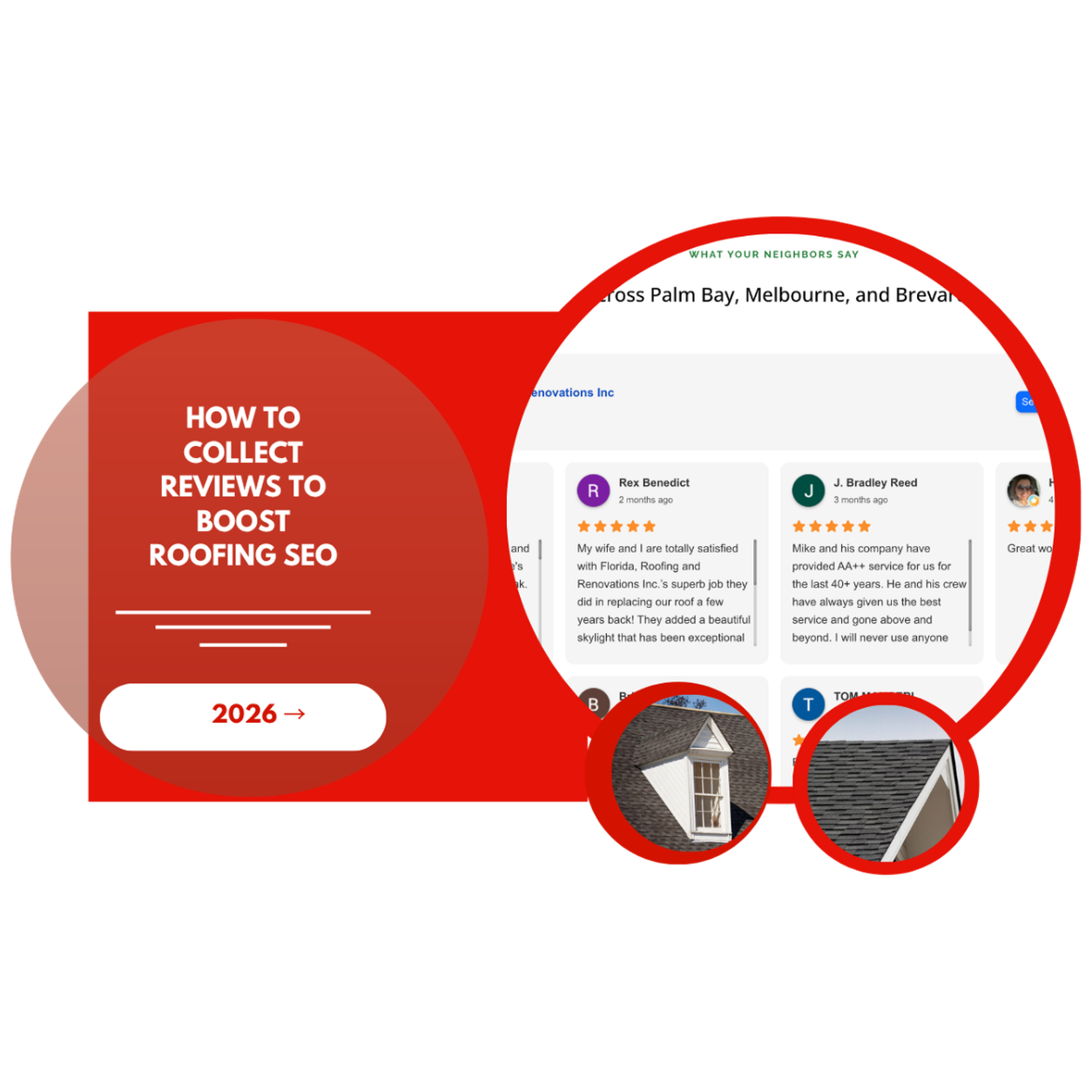
Ask every customer for a Google review within 24 to 48 hours after you finish the job. Ask in person at the final walkthrough, then text them your direct review link so they can post from their own phone, on their own time. Send one reminder, reply to every review, and keep new reviews coming every week instead of in bursts. Sounds simple, right?
Just as important is what not to do. A lot of roofing marketing advice still recommends discounts for reviews, filtering out unhappy customers, or asking homeowners to mention "roof replacement" in their review. Google tightened its review rules in 2026, and it is now deleting reviews collected that way.
Below is the review system we set up for roofing companies at our roofing SEO company, step by step, with copy-and-paste templates you can use today.
How Do Google Reviews Help Roofing SEO?
Google ranks local results on three things: relevance, distance, and prominence. Reviews are a big part of prominence, and Google says directly that more reviews and positive ratings can improve your local ranking.
For a roofing company, reviews do three jobs at once:
- They help you rank in the Map Pack. In a dataset of 16,000+ Business Profiles, profiles with 201 to 500 reviews ranked top 3 about 73% of the time, against 39% for profiles with 1 to 5 reviews. Recency matters too, since in another expert survey, review recency jumped from #93 in 2023 to #11 in 2026.
- They turn searches into calls. 97% of consumers read reviews for local businesses. On a $10,000+ roof, homeowners read even more.
- They feed AI answers. Google's AI features and tools like ChatGPT pull from review text when they recommend local businesses. More on that below.
Reviews work alongside your Google Business Profile. If your profile itself needs work, start with our guide to Google Maps optimization for roofing first, then move to reviews.
Google's 2026 Review Rules in 30 Seconds
On April 17, 2026, Google added two new bans to its Maps review policy: no review quotas for staff, and no asking for specific content in reviews, including a staff member's name (Search Engine Roundtable). The same policy already banned incentives, review gating, and pressuring customers to review while you're on-site.
So, read this before you set up anything below, because several popular roofing tactics now fall on the wrong side of the line.
Google is actively enforcing this. In September 2026, it started emailing owners when it detects a spike in spam reviews: it removes them and temporarily pauses all new reviews on the profile. Google also asks Maps users whether a business offered rewards for reviews, and "yes" answers can lead to deletions, including older reviews.
How to Get More Google Reviews for Your Roofing Company: 8 Steps
This is the non-complicated system we build for roofing clients. Let’s start.
Step 1: Get Your Direct Review Link and QR Code (and Fix Your Profile First)
In your Google Business Profile, open Ask for reviews (sometimes shown as "Get more reviews"). Copy the short link and download the QR code.
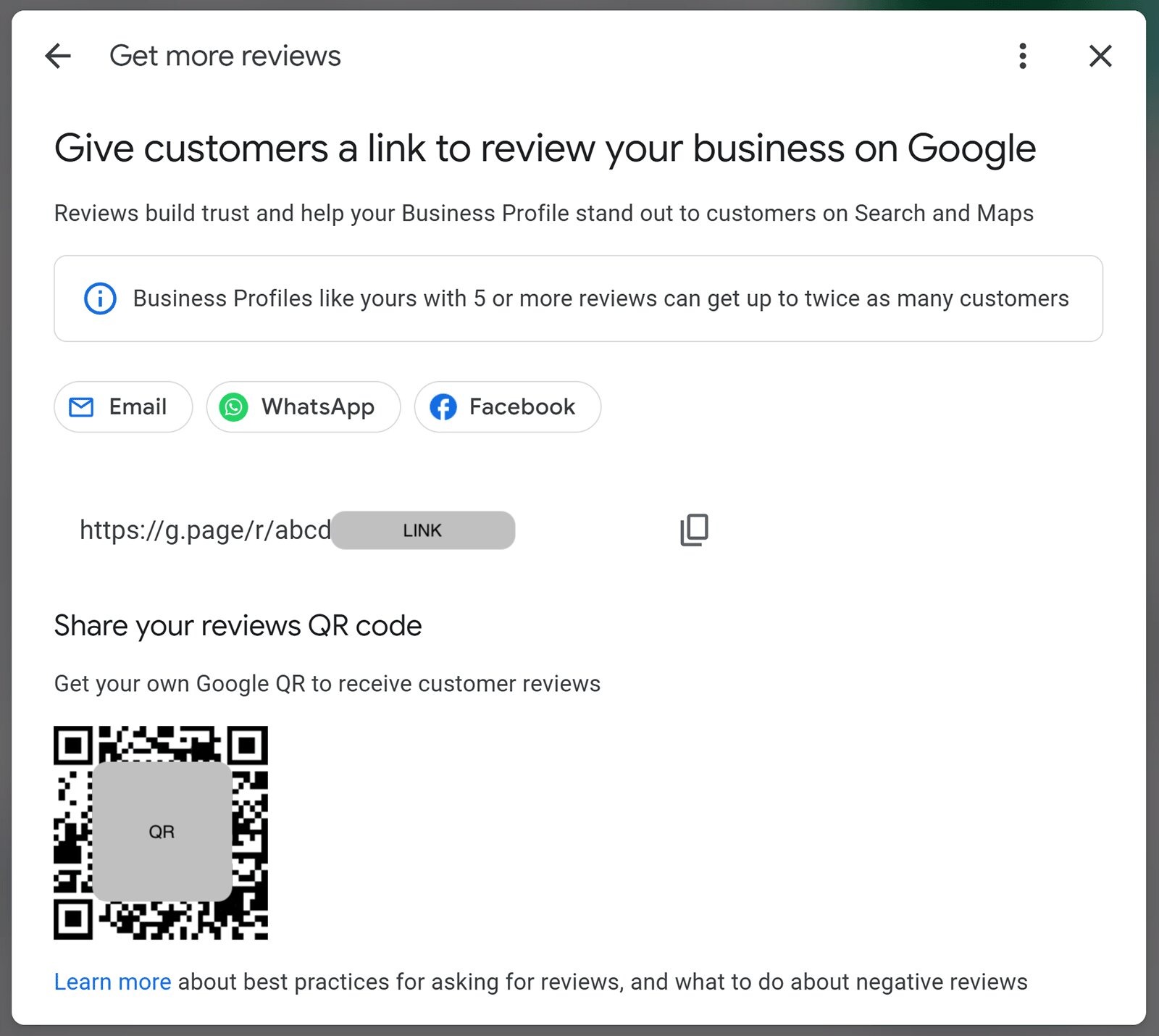
Google formalized its help documentation for review links and QR codes at the end of 2025, so this is the officially supported way to ask.
Before you send that link to anyone, check the profile it points to. Your services, service areas, and categories should match your website. We worked on a case of a California-based roofer whose Business Profile and website listed different services and locations. This gave Google conflicting signals. Once we aligned them and built pages for roof inspections, local pack visibility improved, and leads grew 200%, with inspection inquiries driving most of them.
Step 2: Ask at the Right Moment in the Roofing Job
Timing is the biggest lever you have. You should ask when the homeowner feels the result:
If you miss the in-person moment, send the request within 24 to 48 hours. Don't skip inspection-only and small repair customers. They're real customers with a real experience, and their reviews naturally cover more of your services.
Step 3: Ask in Person, Then Send the Link to Their Phone
Your project manager or crew lead has the most goodwill at the end of the job. Have them ask in one sentence (scripts are below), then text the link to the homeowner's own phone right there.
The compliant version stops at that point. Don't stand over them until they post, and never hand them your tablet. Google's policy prohibits requiring or pressuring reviews while you're on the premises, and reviews from your own devices look like manipulation to its filters.
Step 4: Text First, Then Email
Text messages get read faster than email, and the link opens straight in the customer's phone. Send the text the same day, add an email version for customers who prefer it, then send one reminder three to five days later. After that, stop.
One new detail matters here. As of September 30, 2026, Google Maps requires people to be signed in to a Google account to see all reviews or leave one. A link sent by text usually opens in the Google Maps app, where most people are already signed in, so it creates the least friction.
Step 5: Automate the Request in Your CRM
Manual asking breaks down the first busy storm season. Set your CRM to send the review text automatically when a job is marked complete, or the final invoice is paid. JobNimbus, AccuLynx, Jobber, and ServiceTitan can all trigger this. If you're still choosing, see our roundup of the best roofing CRM software.
With all of these, keep one rule: the automation goes to every completed customer. A setup that asks "how did we do?" first and only sends 4- and 5-star answers to Google is review gating, and Google prohibits it.
Step 6: Leave a QR Code Behind
Put your review QR code on business cards, a fridge magnet, the final invoice, warranty paperwork, and your yard sign. Homeowners keep warranty documents for years, so the code stays in the house. Many customers will review the next time they look at the roof.
Step 7: Ask Your Customers From the Last 90 Days
If you have fewer than 50 reviews, this is your fastest win. Pull every completed job from the last 90 days, have someone in the office call each customer, ask how the roof is holding up, and text the review link to the happy ones and the unsure ones. If someone has a problem, you just found a warranty issue before it became a one-star review.
Spread these requests over several weeks instead of texting everyone on Monday morning. Dozens of reviews arriving in one day can look like a spike to Google's spam filters.
Step 8: Make Asking a Crew Habit
Add "ask for the review and text the link" to your final walkthrough checklist, right after "magnet sweep done." Train every crew lead on the same one-line ask.
You can't set review targets for staff anymore. Google banned directing staff to collect a set number of reviews in April 2026, and per-review bonuses push crews toward exactly the pressure tactics Google filters out. Reward what produces reviews instead: clean job sites, on-time finishes, and zero callbacks.
Roofing Review Request Templates (Copy and Paste)
These are the templates we start clients with. Each one asks for an honest review and leaves the content to the customer, which keeps them inside Google's 2026 rules. Swap in your details and keep them short.
In Person, at the Final Walkthrough (Project Manager or Crew Lead)
"We're all wrapped up. If you're happy with how it turned out, an honest Google review really helps a local roofer like us. I'll text you the link now so you can do it whenever you get a minute."
Text Message, Same Day
Hi [First name], it's [Your name] from [Company]. Thanks for trusting us with your roof. If you have a minute, we'd really appreciate an honest Google review about your experience: [review link]
Text Message, One Reminder (3 to 5 Days Later)
Hi [First name], quick follow-up from [Company]. If you haven't had a chance yet, here's the link to share your experience on Google. It takes about a minute: [review link]. Thanks either way!
Email Version
Subject: How did we do on your roof?
Hi [First name],
Thanks again for choosing [Company]. Reviews from homeowners like you help your neighbors find a roofer they can trust, and they make a real difference for a local business like ours.
If you have a minute, please share an honest review of your experience here: [review link]
If anything about the job isn't right, reply to this email or call me directly at [phone]. I'll fix it.
[Your name], [Company]
Phone Script for Past Customers (Office Staff)
"Hi [First name], this is [Name] from [Company]. We replaced your roof in [month], and I'm calling to check that everything's holding up well. [Listen. If there's an issue, schedule a fix.] Glad to hear it. Would you be open to leaving us an honest Google review? I can text you the link right now."
What to Leave out of Every Template
Discounts or rewards, crew members' names, specific services or keywords ("please mention our metal roof install"), and any star rating ("a 5-star review would help"). Each of these can get the review filtered or removed.
How Many Google Reviews Does a Roofing Company Need?
BrightLocal's 2026 survey of 1,002 US consumers shows how fast expectations are rising:
So here's how we set targets for clients:
- Get past 20 reviews first. Below that, roughly half of homeowners filter you out before they read a word.
- Benchmark the Map Pack. Search "roofer near me" and "roof replacement [your city]" from your service area. Note the review count and the date of the newest review for the top 3. Your target is to match their count and always have a newer review than they do.
- Keep the flow steady. You'll often see advice to aim for 2 to 3 reviews a month. In 2026, that's a minimum: if a third of homeowners want reviews from the last two weeks, you want at least one new review most weeks. Asking after every job gets you there without ever creating a suspicious spike.
Rating matters less than count and recency once you're above 4.5. Only 10% of consumers say they'll only use a business with a perfect 5.0, so an occasional 4-star review with a good reply in fact makes your profile look more believable.
How to Respond to Roofing Reviews (Positive and Negative)
Reply to every review within a day if you can. 80% of consumers say they're more likely to use a business that responds to all its reviews, and 19% expect a reply the same day they post. Your replies are read by the next homeowner far more than by the reviewer.
But skip the copy-paste. The same survey found generic, templated replies put off 50% of consumers. A reply that could sit under any review tells the reader nobody's paying attention.
For Positive Reviews
Thank them by first name and mention one real detail from the job. Mentioning the service or town is fine when it's natural ("Glad the new roof held up through last week's storm in Mesa, Karen"). Don't stuff a keyword into every reply; it reads as if a robot wrote it.
For Negative Reviews
Use this four-step reply:
- Acknowledge the problem without arguing or dismissing it.
- Take it offline with a name and direct phone number.
- Fix it. In the client profiles we manage, most roofing complaints come down to communication, cleanup, or a missed callback, and those are fixable.
- Come back and add a short note once it's resolved. Some customers will update their review on their own.
If a review is fake or from someone who was never your customer, don't fight it in the reply. Report it (see the review-bombing section). For a full playbook on handling complaints and protecting your rating, see our roofing reputation management guide.
Do Reviews on Yelp, Facebook, BBB, and Apple Maps matter?
Google comes first because Google reviews are what help your Map Pack rankings. But the average consumer uses six different review sites when choosing a local business, and Apple Maps usage nearly doubled in a year, from 14% to 27%.
Other platforms matter for two reasons. They reassure the homeowner who double-checks you before signing a pricey contract, and they give AI tools more sources that agree about you. One marketing agency CEO told Roofing Contractor that BBB listings and reviews seem to be gaining traction as a source in AI search. We also see a similar trend.
Our rule of thumb: send Google links by default. Once your Google profile is past your local competitors, rotate in Facebook, BBB, or Yelp for some customers, especially ones who mention they found you there. Never ask the same customer to post on three sites; you'll get none.
How Do Reviews Help Roofers Show Up in AI Search?
AI tools now read your reviews and repeat what they say. Google's Ask Maps, launched in March 2026, answers questions like "a roofer who handles hail insurance claims and cleans up well" partly from review text. Plus, 45% of consumers now use AI tools for local recommendations, up from 6% a year earlier.
So what your reviews say really matters. "Great job!" gives AI nothing to match. You can't tell customers what to write, but you don't need to. Ask for an honest review of their experience, and homeowners who just got a new roof will naturally mention the storm damage, the insurance claim, the crew, and the cleanup.
Back that up with service pages that clearly describe what you do and a Business Profile that matches them. That's the core of our AI search optimization for roofing companies.
To start on your own, read how to do AI SEO for roofers.
Review Mistakes That Get Roofing Reviews Deleted
If your review count has dropped or stalled, one of these is usually the reason:
- Offering anything for a review. Discounts, gift cards, a free gutter clean, a raffle entry. Google’s policy bans incentives outright.
- Filtering unhappy customers (review gating). Sending a "rate us 1 to 5" survey and only sending the 4s and 5s to Google. Some review software still sells this as a feature.
- Writing the review for the customer. Including tools that draft a review from a phone call or "AI-write" it for the homeowner to paste. The review stops being the customer's own words, and the FTC's rule on consumer reviews specifically covers fake and AI-generated reviews.
- Asking for specific content. "Mention Mike, our project manager," or "Please say roof replacement in Phoenix." Both now count as rating manipulation.
- Reviews from employees, family, or your sub-crews. Any conflict of interest counts, including subcontractors.
- Blasting your whole customer list in one day. Real customers, but the burst looks like a spike and can pause your reviews.
- Buying reviews or hiring a vendor who "guarantees" them. In May 2026, the FTC and Illinois sued a home repair company that allegedly had employees, relatives, and SEO companies post fake five-star reviews to bury real one-star ones. The FTC's review rule allows civil penalties of up to $53,088 per violation, and you're responsible for what a vendor does in your name.
What to Do If Your Roofing Company Gets Review-Bombed
Fake one-star attacks, sometimes followed by a demand for money to remove them, have hit roofers across the country. Roofing Contractor reported that Amstill Roofing in Texas was hit with 300 one-star reviews and dropped to 3.2 stars in a matter of hours. Getting them removed took about three months.
If it happens to you:
- Don't pay, and don't reply angrily. Paying invites the next round.
- Document everything. Screenshot each review, reviewer profile, and any message demanding payment.
- Check every review against your job records. No matching customer, address, or date is your strongest evidence.
- Report each review in Google Business Profile, then escalate through Google Business Profile support with your evidence in one file.
- Keep asking real customers. Your normal review flow is what pulls the rating back up while the removal requests work through.
Google is getting faster at this. Since September 2026, it emails owners when it detects a spike in spam reviews, removes them, and briefly pauses new reviews on the profile. If your reviews suddenly stop coming in, check your Business Profile email before assuming something is broken.
The best defense is volume you built before the attack. Amstill's owner said exactly this: his answer to the next attack is having a huge number of genuine Google reviews. Do the math: 50 fake one-star reviews drag a 4.9 profile with 40 reviews down to about 2.7, while a profile with 600 reviews only drops to about 4.6.
Should You Show Reviews on Your Roofing Website?
Yes, but for conversions more than rankings. After reading positive reviews, the most common next step for consumers is visiting the business's website. Show them the same proof again where they decide: next to your quote form and on each service page. Our roofing landing page guide covers placement in more detail.
Two technical points to get right:
- Don't mark up your own Google reviews to get stars in search. Google treats reviews a business collects about itself and displays on its own site as self-serving, so they aren't eligible for review stars. Since July 24, 2026, Google's review snippet guidelines also explicitly ban fake or undisclosed incentivized reviews on the page or in markup, with a manual action as the penalty. If a plugin added review schema to your site, have it checked as part of a technical roofing SEO review.
- Video testimonials help close your sale. They're great on service pages and in your follow-up after an estimate, but they don't count toward your Google review total. Collect Google reviews first.
Start Today: Your Review Checklist
- Copy your Google review link and download the QR code
- Check that your Business Profile services and service areas match your website
- Save the same-day text template on your phone
- Add "ask for the review, text the link" to your final walkthrough checklist
- Set your CRM to send the request when a job is closed or paid
- Text your last 90 days of customers, spread over two to three weeks
- Remove any incentives, rating filters, staff-name requests, or review quotas from your process
- Reply to every review this week
Reviews are one piece of a bigger local SEO system. They work best alongside a strong Business Profile, service and location pages, and links from sites Google trusts in your area. If you want to see where your roofing company stands, our expert team can run a free roofing SEO audit, or fully handle your review system through our roofing reputation management service.
FAQs: Collecting Reviews for Roofing SEO
How Long Does it Take for New Reviews to Improve My Map Pack Ranking?
There's no verified timeline. What we see consistently is that steady, recent reviews outperform a one-time burst. Combine reviews with a well-optimized Business Profile and strong local pages for the biggest effect.
Can I Ask Customers From a Few Tears Ago for a Review?
Yes, as long as they're real customers with a real experience. Start with the last 90 days, because those memories are fresh, then work further back. Spread the requests over several weeks to avoid a spike.
Do Replies to Reviews Help My Rankings?
Replies mainly help conversions: homeowners read how you handle feedback before they call. Google also says responding to reviews shows you value your customers. Treat replies as part of the job, not as a ranking trick.
Why Did My Google Reviews Suddenly Disappear?
The usual causes are Google's spam filters catching a pattern (a spike, a shared device, reviews from the same network) or a policy sweep removing incentivized or conflict-of-interest reviews. Check your Business Profile email first: Google now notifies owners when it removes spam reviews and pauses new ones.