



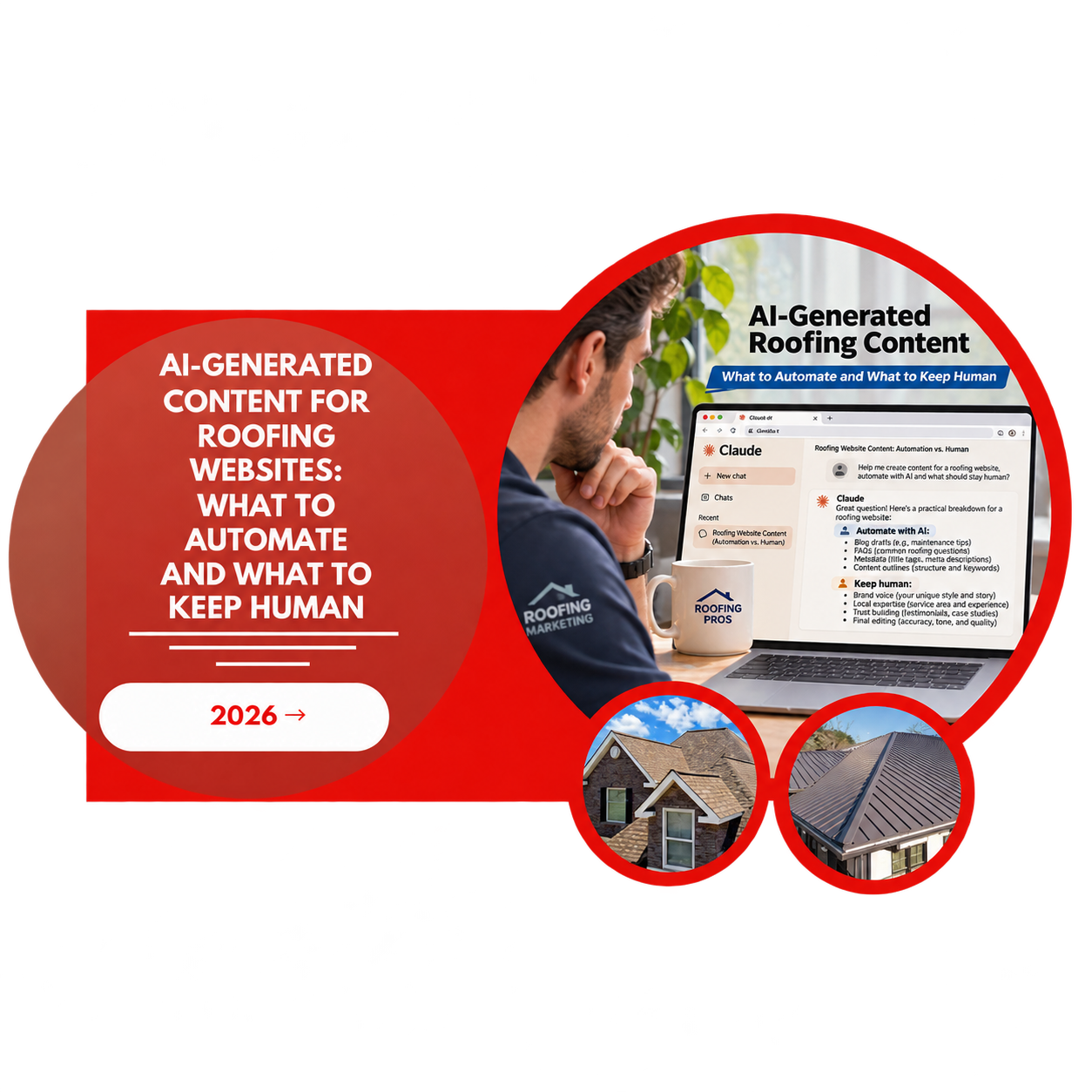
Your roofing website needs good content to rank well, but between estimates, job sites, and storm season, you don't have time to write it. AI seems like an easy fix, until you hear it might get your site penalized.
In reality, AI isn't the enemy, but it's not a hands-off shortcut either. It works best for repetitive tasks like meta tags, schema, initial service page drafts, and turning crew job notes into project updates. However, the details homeowners care about most, like your pricing, warranties, licenses, insurance guidance, reviews, and real project photos, must stay strictly human.
You can automate parts of your content creation, but not the whole process.
As a specialized roofing SEO agency, we audit roofing sites every week and see the same AI mistakes repeatedly. So, here is what is safe to delegate, where AI saves you the most time, and where it puts your business at risk.
Quick Overview: Which Website Content to Automate or Keep Human?
Take a quick look at the table, after which, I’ll explain each one in more detail.
Does Google Penalize AI-Written Roofing Content?
No. Google doesn't penalize content because AI helped write it. It cares whether content is helpful, not how it was produced.
Still, Google penalizes content that's thin, repetitive and published mainly to rank. Its spam policies target scaled content abuse: lots of pages made to manipulate rankings that give readers little value. That rule applies whether a person, a tool or both wrote the pages.
In our experience, on roofing websites, that usually looks like:
- A page for every town within 40 miles where only the town name changes
- "Benefits of metal roofing" posts that could run on any roofer's site in any state
- Service pages that say "quality workmanship" and "customer satisfaction" but never explain how you do the job
Google is actively enforcing this. Its most recent spam update ran from September 24 to October 8, 2026. Sites full of pages like the ones above are the ones that tend to lose ground.
So the real question isn't "AI or not." It's whether each page tells a homeowner something valuable and something only your company could tell them. That's the test behind everything below.
What Roofing Content Can You Safely Automate
The safe zone is any task where AI reshapes information you already have. It's risky as soon as AI has to come up with the facts itself.
Meta Titles, Descriptions and Schema Markup
This is the easiest use of AI for content. Paste a page into AI with its target keyword and ask for a title tag and meta description. Then check that the city and service are right, and that the description doesn't promise something the page doesn't deliver, like "free inspections" if you charge for them.
AI is also good at drafting schema markup (the code that tells Google your business type, services and service area). Just validate it before it goes live. A wrong phone number in the schema spreads to everything that reads it. The team of technical SEO at Roofex uses AI for exactly this first pass, before doing deeper audit.
Project Posts From Crew Notes and Photos
This is the habit that saves our roofing clients the most time. After a job, the crew lead records a one-minute voice memo: what they found, what they replaced, anything unusual. Rotted decking under the second layer, a chimney with no cricket, a valley flashed wrong by the last roofer. Add five photos.
AI turns that into a clean project post. The project manager reads it before it goes live. The content is original because the facts came from your job site, and nobody spent an hour typing.
FAQs Built from Real Customer Questions
Don't ask AI "what do homeowners ask roofers?" You'll get the same ten answers as every other roofing site. Instead, have your office and crew write down the questions they really hear on the phone, during inspections or a repair. These are questions like:
- Do you pull the permit?
- Will you cover my landscaping?
- Can you match my old shingles?
Give that list to AI to draft answers, and the owner fixes anything about price, timing or insurance.
Replies to Positive Reviews
Google itself is testing a "reply to reviews with AI" button inside Google Business Profile. For a short "great job, fast crew" review, an AI draft that you tweak and post is fine.
Draw the line at negative or detailed reviews. Customers notice canned replies, and 60% of consumers say they lose trust in a business that uses AI to answer reviews. A person who knows the job should write those to do proper roofing reputation management.
Updating Old Pages
AI is good at spotting what's stale: last year's date in a headline, a shingle line the manufacturer discontinued, a broken link. Let it flag the problems, and then a person decides what to change.
What AI Can Draft, but You Must Finish
These are the pages that bring in leads. AI can give you a structure in minutes, but the page only ranks and converts once someone adds what only your company knows.
Service Pages
Ask AI for a roof replacement page and you'll get a tidy outline: signs you need a new roof, the benefits of replacing, why choose us. Every roofer in your market has that page, and some have probably used AI to make it.
What makes yours different has to come from you:
- Your actual process, from tear-off and decking inspection to ice and water shield, ventilation and cleanup
- The shingle and membrane brands you install, and any manufacturer certifications you hold
- How long a typical job takes your crew
- The problems you see most in your specific area, whether that's hail, ice dams, coastal wind or sun damage
- Photos from your own jobs
Service pages are also your sales pages, so structure matters as much as copy. Our guide to roofing landing pages covers the conversion side.
Blog Posts and Material Comparisons
AI writes a decent first draft of "asphalt vs. metal roofing." It also gets lifespans, warranty lengths and product names wrong often enough that every number needs a second look. Once the facts are checked, add the part a homeowner can't get anywhere else: which material you'd really recommend for their house, and why.
This is an amazing chance for you to show your expertise in the region and authority (core elements of roofing EEAT) by maybe simply adding real quotes from your crew or cases you have dealt with.
City and Service-Area Pages
This is where AI does the most damage on roofing sites. It takes ten minutes to generate 30 city pages, and that's exactly the kind of content Google's scaled content rules are built to catch.
Our rule is simple: no local proof, no page! Only build a city page if you have at least one of these for that town:
- Jobs you've completed there, with photos
- Reviews from customers who live there
- Something local worth explaining, like a recent storm, a common roof style or a permit quirk
AI can help format the page once you have that material, but it can't invent it in proper quality. To decide which towns are worth a page first, check search demand with our free roofing keyword explorer, and support each page with a well-maintained roofing Google Business Profile.
Storm Damage and Insurance Pages
Again, AI can outline the general claim process: document the damage, call the carrier, schedule an inspection, review the adjuster's scope. Everything past that needs a person who knows how claims work in your state specifically. Never promise coverage, and never suggest you can negotiate a claim on the homeowner's behalf unless your state allows it.
Storm content is also where local knowledge pays off most. To give an example, we worked with a small Texas coastal roofer, whose website wasn’t earning links or any trust with generic roofing content. So we built content around Gulf Coast wind damage patterns, typical repair costs after coastal storms, and what insurance claims look like after Gulf events. Local news and housing sites linked to it, and we pointed that authority at the storm repair and insurance claim pages. Within nine months, organic traffic was up 801% and leads were up 350%. No AI tool could have produced that content, because it came from knowing the market.
What to Keep 100% Human
Anything a homeowner could hold you to, stays with a person: a number, a promise, a credential or proof of your work.
This matters more now because AI tools summarize your business for homeowners, using your website as a source. 82% of consumers say they read AI-generated summaries of a business's reviews, and AI search tools pull from your website the same way. If your site has a wrong price or a warranty you don't offer, the AI repeats it to everyone who asks.
Prices and Cost Ranges
AI fills in national averages that don't match your labor rates, your materials or your market. If you publish the wrong number, you either lose money or lose the homeowner when the real quote comes in higher.
There's a newer reason to get this right. For home repair, Google now lets people ask it to call businesses on their behalf to check prices and availability. The price on your site, the services in your Google Business Profile and what your office says on the phone should all match.
So, publish ranges you set yourself, such as a typical repair or a full replacement for an average home in your area, and review them every season.
Licenses, Certifications and Warranties
AI loves to generate confident, generic claims like "fully licensed and insured in [state]." That's often wrong. Licensing rules vary a lot state by state. Some license roofers statewide, while others, like New York, leave it to cities and counties. AI also tends to list manufacturer certifications you don't hold or warranty lengths you don't offer.
Every license number, certification and warranty term on your site should be checked by the owner.
Reviews and Testimonials
Never generate, invent or "polish" a review. The FTC's rule on fake reviews bans reviews from people who don't exist, including AI-written ones, and the penalties apply per review.
Project Photos and Case Studies
Some roofing software can now generate an AI "after" image from a photo of a damaged roof. That's fine as a clearly labeled preview during a sales visit. It should never appear in your portfolio as finished work.
98% of insurers say AI editing tools are driving more insurance fraud. So if you do roofing insurance work as well, real photos protect your reputation with carriers too.
Case studies need a real conversation with the project manager or homeowner: what you found, what you did and how it turned out.
Your About Page and Team
Years in business, how the company started, who's on the crew, which local teams you sponsor. This is the real-world experience Google says it looks for, and AI can't produce it for you. Fabricating these creates both ranking and reputation risks that you might not recover from.
How to Use AI on Your Roofing Website: A Simple Process
Now, you know where to use and not use AI in your roofing content creation. So let me share a simple process our writers came up with for roofing pages, and it works just as well for a small in-house team:
- Gather the raw material first. Job photos, crew voice memos, the questions your office hears, recent reviews and your price sheet. If you have nothing specific to say about a topic, don't write the page yet.
- Let AI draft from that material. Paste in your notes and ask for structure and clean wording. Avoid blank prompts like "write a page about roof repair."
- Add what only you know. Every page should include at least one real job, one local detail and one opinion from someone on your team.
- Check every claim. Highlight each price, license, warranty, timeline and insurance statement. The owner confirms it, or it comes out.
- Run the "any roofer" test. Read each paragraph and ask: could a roofer in another state publish this unchanged? If yes, rewrite it or cut it.
- Publish a few strong pages at a time. Four good pages a month will do more for you than 40 thin ones in a week.
If your team doesn't have time for steps 3 and 4, that's the part worth handing to specialists. It's exactly what our Roofex’s content writing for roofers covers.
Signs Your Site Already Has an AI Content Problem
If you or a previous agency already used AI on your site, here's what to look for. These are the issues we find most often when we audit roofing websites.
- City pages that open with the same paragraph. Read three of them back to back. If only the town name changes, Google sees the same thing.
- Filler phrases. "When it comes to your roof," "in today's fast-paced world," "look no further." Homeowners skim right past them, and they signal a page nobody edited.
- Blog posts with no photos, no jobs and no names. A post about hail damage that never mentions a hail storm in your area isn't helping you.
- Claims you can't back up. Shingle brands you don't install, certifications you don't hold, a "lifetime warranty" you've never offered.
- Leads that arrive confused. Callers ask about a service you don't do, or quote a price from your site that's out of date.
- Your website and Google Business Profile disagree. Different services, different service areas, different hours.
That last one is more common than you'd think, and it costs rankings. A California roofing company came to us with a website and Google Business Profile listing different services and locations, so Google was getting mixed signals about what they did and where. Once we aligned the two and built pages for the services people were searching for, leads grew 200% within three months.
Check Whether the Latest Spam Update Affected You
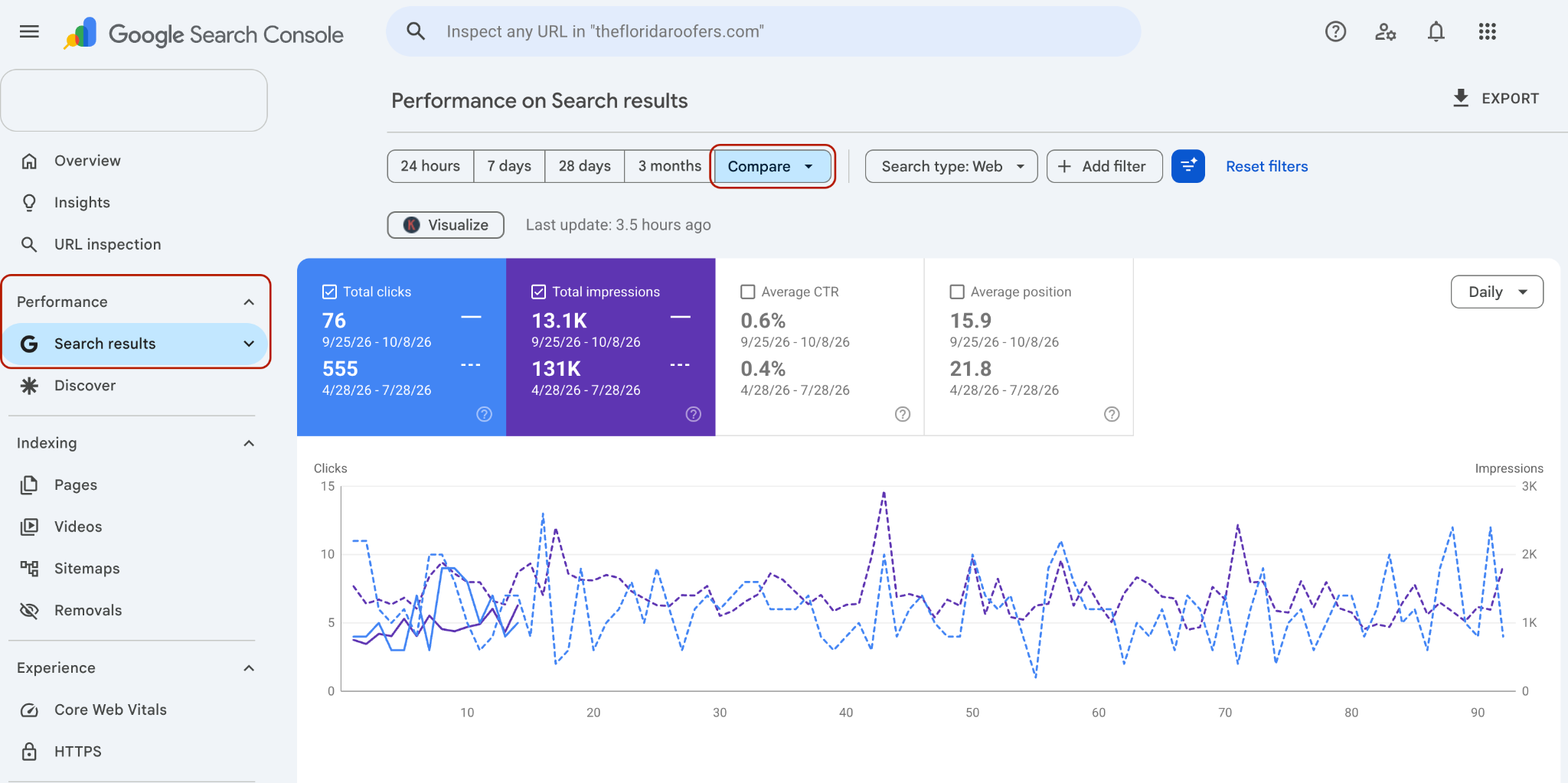
Google doesn't notify you when an algorithm update hits your site. To check the last one, open Google Search Console, go to Performance (Search Results), and compare September 25 to October 8, 2026 with the two weeks before. Then sort pages by clicks lost. If the losses cluster on templated city pages or thin blog posts, that's your answer.
How to Fix It
- Start with pages that still get traffic. Add real jobs, photos and local detail before touching anything else.
- Merge thin city pages. Fold towns you rarely work into into a stronger regional page, and redirect the old URLs.
- Remove pages with nothing to save. No traffic, no links and nothing local to say? Take them down.
- Fix every wrong claim right away, on the site and in your Google Business Profile.
If you'd rather have someone else find the problem pages, our roofing SEO audit at Roofex flags them and tells you which to fix first.
The Bottom Line
Use AI for the busywork: tags, schema, outlines and first drafts built from your own job notes. Keep the facts with people: prices, licenses, warranties, reviews, photos and the stories of real jobs. Do that, and you publish faster without giving Google, or the homeowners reading AI summaries of your company, a reason to doubt you.
If you’re not sure which pages on your site cross the line, contact us for a free proposal, and we’ll show you where you stand in Google, Maps and AI search, and what are the steps to optimize your content efficiently.
Frequently Asked Questions
Do I have to tell visitors my website was written with AI?
In most cases, no. There's no general US rule requiring you to label AI-assisted website text. Google's helpful content guidance suggests explaining how content was made where readers would reasonably expect it. What you should never do is present AI text as a personal story or a crew member's experience.
Can I use AI to translate my site into Spanish?
Yes, as a first draft. Have a native speaker review it, give each language its own URL as Google recommends for localized versions, and only translate pages your office can actually support in that language, including phone calls.
Can an AI website builder write my whole site?
It can build the layout quickly, but the copy it produces is usually the generic text that fails the "any roofer" test. Use the builder for design, then replace the words with your own. Our review of roofing website builders compares the options.